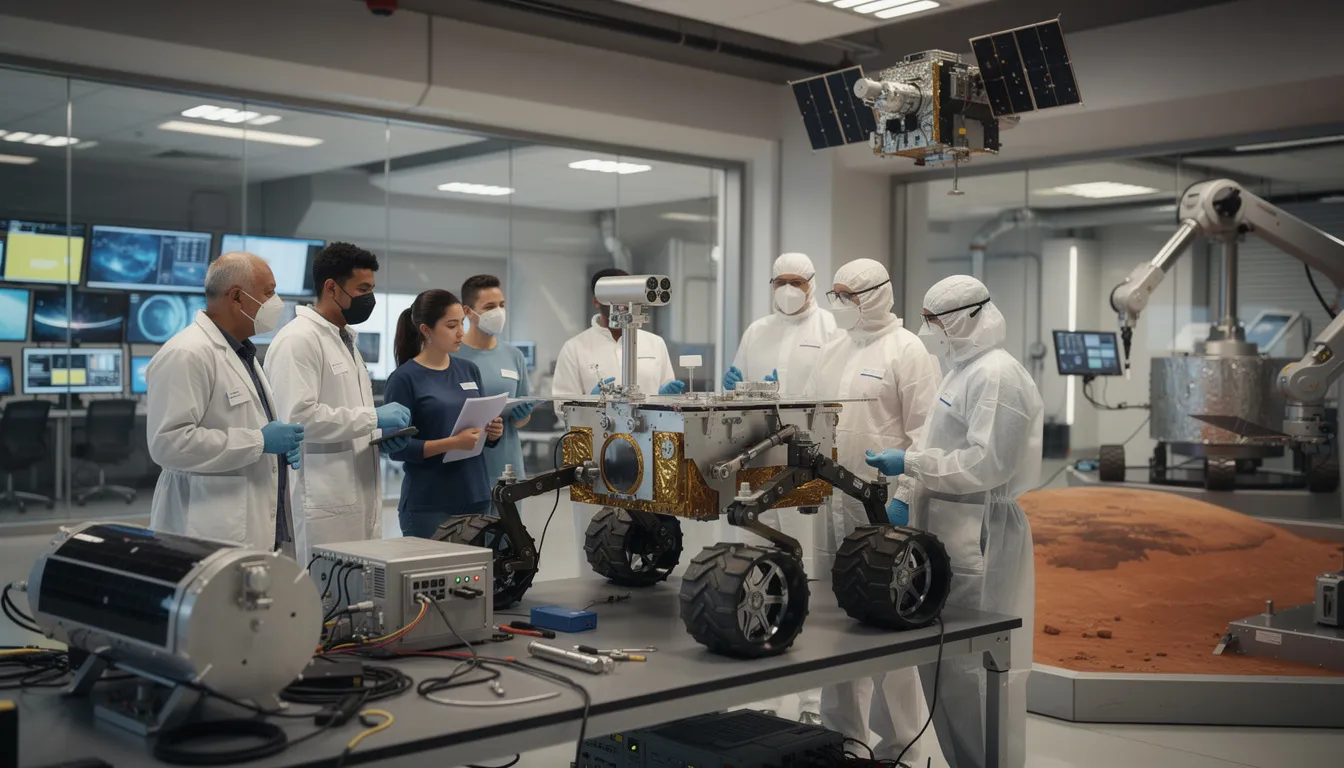
From new ways to talk to spacecraft to bold steps on Mars, the Jet Propulsion Laboratory turned 2023 into a year of tangible progress. Teams refined the next wave of exploration while keeping long-lived missions healthy and productive. If you want a snapshot of where space technology is heading, this is it. Here is what made jet propulsion laboratory 2023 stand out.
💡 Keys Takeaways
- JPL’s budget and funding for 2023
- Number of successful missions launched this year
- Collaborations with international space agencies
Overview of Jet Propulsion Laboratory in 2023
As a NASA-managed federally funded research and development center operated by Caltech, JPL navigated 2023 with focused priorities and steady momentum. The lab’s portfolio spanned robotic exploration, Earth science, deep-space communications, and technology demonstrations that push the edge of what’s possible.
Funding remained solid as JPL executed on flagship missions and critical infrastructure. The lab operated on an estimated FY2023 program budget of about $2.6 billion, backed by NASA’s enacted appropriation. That support kept more than 6,000 employees and hundreds of on-site contractors working on spacecraft integration, mission operations, and advanced R&D across Pasadena-area facilities and test ranges.
By the numbers, jet propulsion laboratory 2023 delivered at least 1 JPL-led interplanetary launch, sustained operations for dozens of active spacecraft, and advanced multiple flagships through assembly and test. The lab also deepened ties with partners in Europe, India, Canada, and Japan to align schedules and share risk on complex, multi-year missions.
Key Innovations and Technologies
JPL’s technological engine was in high gear throughout 2023. The lab balanced near-term mission needs with bold demonstrations that will unlock faster data, smarter autonomy, and more efficient operations for future explorers.
One of the year’s most visible leaps came from optical communications. The Deep Space Optical Communications experiment rode to space with Psyche, proving the feasibility of beaming high-bandwidth laser data from deep space back to Earth. Instead of squeezing science through narrow radio channels, future missions could return rich imagery and instrument data in minutes rather than hours.
Technological Breakthroughs
Several advances stood out for jet propulsion laboratory 2023, both on flight systems and ground infrastructure:
- Deep Space Optical Communications: High-rate laser links validated the path to future Mars and outer-planet missions with order-of-magnitude higher data throughput than traditional radio.
- Onboard autonomy: Perseverance refined AI-driven hazard detection and route planning, while Ingenuity’s flight software matured reusable helicopter operations on another planet.
- Synthetic aperture radar: NISAR’s L-band radar, built with ISRO collaboration, reached critical integration milestones, paving the way for daily, cloud-penetrating views of Earth’s changing surface.
- Radiation-hardened electronics: Next-gen avionics and power systems completed environmental testing to withstand the harsh thermal and radiation environments of deep space.
Equally important were the behind-the-scenes upgrades. The Deep Space Network added precision timing, improved uplink capabilities, and optical support readiness to receive laser communications at dedicated telescopes. These changes do not just help one mission; they raise the ceiling for the entire fleet.
For teams and students, JPL continued to share open architectures and lessons from fielded systems. The F’ (F Prime) flight software framework that helped Ingenuity fly remained a model for rapid prototyping and robust, test-driven development, making complex spacecraft behavior more accessible to small teams without sacrificing reliability.
Major Projects and Missions
From the asteroid belt to the Martian surface, 2023 kept JPL mission control busy. The year mixed first-of-a-kind launches, steady rover work, and high-stakes testing for the next wave of spacecraft now moving toward their launch pads.
At the center of the calendar sat Psyche, a metal-rich asteroid explorer that lifted off in October carrying both advanced ion propulsion and the optical comm demo. That single ride combined science, propulsion, and communications innovation in a way few missions can.
Recent Developments
Highlights that defined jet propulsion laboratory 2023 included:
- Psyche launch: A successful ascent set the stage for a multi-year cruise to the main belt. The mission’s solar electric propulsion system began checkout, and DSOC started exercising deep-space laser links.
- Mars Perseverance and Ingenuity: Perseverance built out its sample cache strategy after completing a 10-tube depot early in the year. Ingenuity continued to expand the helicopter flight envelope, proving aerial scouting as a practical tool for surface science.
- Europa Clipper progress: The spacecraft underwent integration and environmental testing, from instrument fit checks to thermal-vacuum runs, steadily converging on flight readiness.
- Mars Sample Return (MSR) planning: Teams iterated on architectures to balance risk, schedule, and budget with ESA partners, protecting the scientific value of Perseverance’s samples.
- Earth science momentum: Following its late-2022 launch, SWOT delivered its first year of water-surface snapshots, informing flood forecasting and reservoir management with unprecedented spatial detail.
- Voyager and the Deep Space Network: JPL navigators managed a delicate recovery of Voyager 2 communications after a mispointing event, showcasing DSN sensitivity and long-distance problem-solving.
How many JPL-led launches made it off the ground this year? The answer is straightforward. In 2023, the lab logged 1 successful, JPL-managed interplanetary launch with Psyche, while also contributing instruments, detectors, or operations support to partner-led missions that flew during the year.
Collaboration with Other Agencies
JPL does not go it alone, and that is a strength. The lab’s 2023 calendar wove together international hardware deliveries, joint testing, and science planning to keep major partnerships synchronized.
- European Space Agency (ESA): JPL supported ESA’s Euclid mission with critical detectors and U.S. science participation, and worked hand in hand on Mars Sample Return, alongside planning for Earth Return Orbiter interfaces.
- Indian Space Research Organisation (ISRO): The joint NISAR mission advanced through integration, combining JPL’s L-band radar with ISRO’s S-band system and spacecraft bus for a unified Earth observation platform.
- Canadian Space Agency (CSA) and European partners: For SWOT, JPL continued operations with CNES and CSA contributions, transforming river-lake mapping and oceanography with daily, global-scale data.
- Japan Aerospace Exploration Agency (JAXA): Instrument teams coordinated on mission development and technology exchanges, sustaining a pipeline of joint science investigations.
These collaborations diversify expertise, reduce risk, and stretch budgets. They also make the science richer, aligning observation strategies, cross-calibrating instruments, and opening data to broader research communities.
Community Impact and Engagement
The footprint of jet propulsion laboratory 2023 extended well beyond mission control. In classrooms, small businesses, and neighborhood streets around Pasadena and Los Angeles, JPL’s presence translated into careers, curiosity, and community pride.
Funding rippled through the regional economy via procurements, specialized manufacturing, and services tied to mission development. Small businesses benefited from competitive contracting opportunities, especially those offering precision machining, advanced materials, and software assurance. For students and early-career professionals, paid internships and fellowships paired hands-on projects with mentorship from seasoned engineers and scientists.