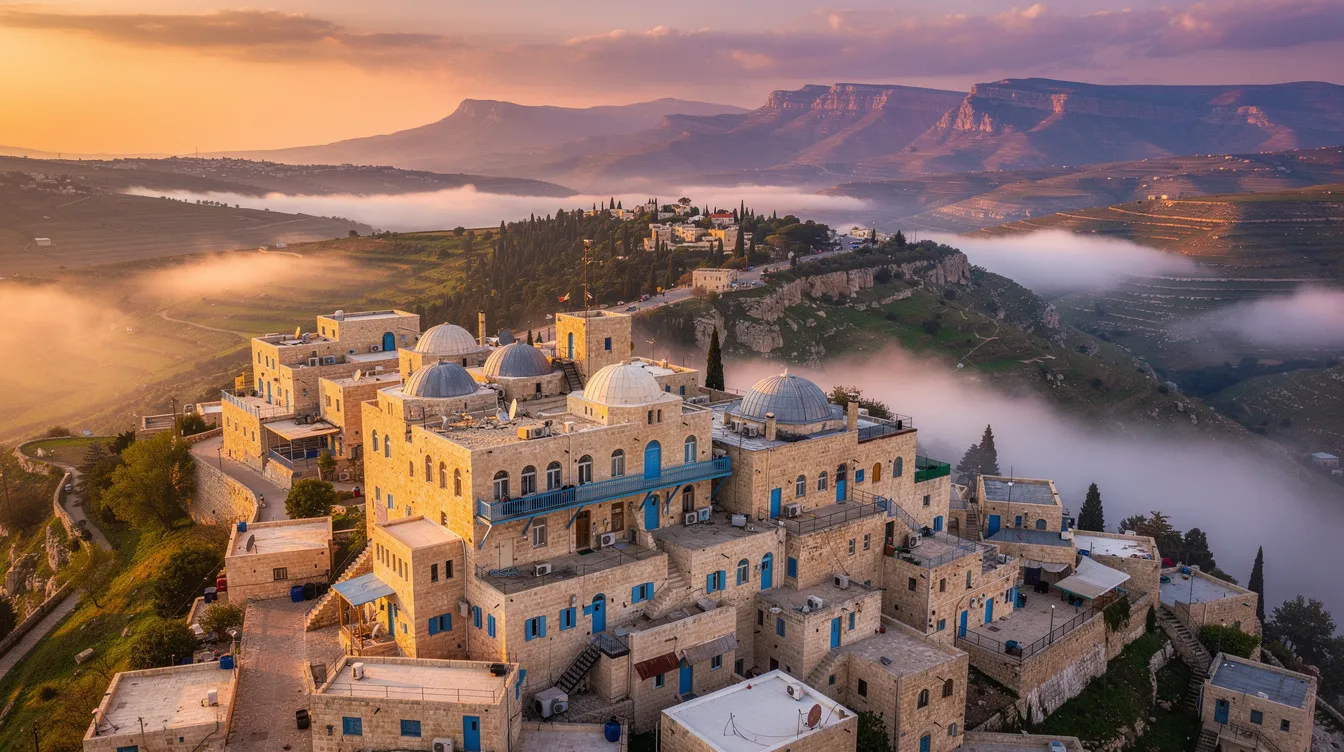
High in the Upper Galilee, a hill town of pale stone and cobalt doors catches both the eye and the imagination. Safed feels like a place where stories walk alongside you, where alleys smell faintly of beeswax and pine, and where prayer and poetry meet in the wind. Come for sweeping views over the Hula Valley; stay for the art, the mysticism, and the gentle hush that settles at sunset.
💡 Key Takeaways
- Safed is one of the four holy cities of Judaism.
- In 2024, Safed’s population is approximately 38,687.
- The city is situated at an elevation of 850 m, making it the highest city in Israel.
Introduction to Safed
Perched at 850 m above sea level, this Galilean gem offers cool mountain air, a labyrinth of limestone lanes, and cloud-brushing views toward Mount Meron. It is widely regarded as the spiritual capital of Jewish mysticism, a place where scholarship once exploded into song and symbol. As one of the four holy cities of Judaism, it balances sacred legacy with an easygoing, artful rhythm that welcomes every kind of traveler.
Part of the town’s magic is sensory. Morning light warms the alleyways and turns blue-painted doors electric; bells from a distant yeshiva blend with the clink of a jeweler’s tools. The market hums before Shabbat, challot stacked like braided crowns. In 2024, the community feels intimate, its skyline low and its stories high, the kind of destination where you greet the same baker twice in a day and he remembers your order.
If you like your wandering to come with altitude and authenticity, this highest city in Israel delivers. The climb rewards you with long vistas to the Jordan Rift and a night sky untarnished by city glare. This is a place for unhurried steps, for pausing at a doorway to watch candles being poured, or for listening to a clarinet drift out from a studio in the Artists’ Quarter.
The Historical Significance of Safed
History here reads like a palimpsest. Crusaders carved out strongholds and guarded mountain roads; Mamluks rebuilt; Ottoman rulers presided over a textile boom that once sent dyed wool far and wide. Each era left a trace in the basalt foundations, in lintels carved with pomegranates, and in synagogues where sages prayed and poets composed liturgical melodies that still echo.
By the 16th century, the town was a magnet for scholars fleeing Iberia. That Golden Age brought printers, mystics, and jurists whose ideas would travel across the Jewish world. The city’s lanes protected more than workshops and homes; they shielded schools where students debated meaning late into the night, harmonizing philosophy, law, and the emerging language of Kabbalah.
Key Historical Events
Crusader garrisons recognized the value of these heights and fortified approaches to the Galilee, traces of which remain in stones recycled into later buildings. Under the Mamluks, the town regained importance as a regional node, and by the Ottoman period it thrived on textiles and religious learning. The 1500s saw the arrival of giants like Rabbi Joseph Caro, who compiled the Shulchan Aruch, and Rabbi Moshe Cordovero, a leading mystic whose systematic approach shaped later thought.
Earthquakes periodically tested the town, toppling walls and prompting rebuilds that layered styles and periods in one neighborhood. The 1837 quake, in particular, reshaped quarters and prompted new construction techniques. In the 19th and 20th centuries, pilgrims, artists, and pioneers arrived, adding Hebrew printing presses and modest hotels. That long arc from Crusader fortifications to the Ottoman 16th century Golden Age explains why every corner seems to hold a footnote, and why even casual walks feel like guided tours through time.
Cultural and Spiritual Hub
What sets this hill town apart is its living spirituality. The sacred is woven into daily life, from mezzuzot chiseled with delicate micro-calligraphy to melodies that spill from late-night study halls. Kabbalistic language surfaces on gallery walls, in swirling pomegranates, in the seven-branched lines of a candelabrum painted on a door. Even the blues that tint windows and thresholds carry layered meaning, invoking protection and sky in one stroke.
I remember pausing outside a small workshop where a scribe was hand-inking a mezuzah. He explained how each letter is intentional, a bridge between idea and action. Another afternoon, I watched a candle-maker shape Havdalah braids, his hands moving as if in prayer. Encounters like these help a visitor understand why this place is not just historic; it is actively, gently, sacred.
Music is part of the atmosphere. On quiet afternoons, a clarinetist might rehearse a nigun in a courtyard while an artist mixes pigments upstairs. Friday evenings transform the town into a soft chorus of song and footsteps as people head to synagogue, crisp white shirts glowing in dusk. The experience is immersive yet inviting, allowing you to participate at your own pace, whether through study, song, or contemplation at a lookout.
Safed’s Role in Jewish Mysticism
In the 1500s, mystics here reshaped religious imagination. Teachings associated with the Kabbalah evolved from abstract ideas into frameworks that shaped ritual, ethics, and daily practice. The Ari, Rabbi Isaac Luria, introduced a dynamic cosmology of broken vessels and tikkun, a call to repair that resonated far beyond scholarly circles. That ethos still animates the town. You see it in art that pulses with symbolic fruit and light, in prayers chanted at dusk, and in guided classes where a local teacher unpacks a verse and connects it to modern life.
For visitors, this heritage is not academic. A short class on mystic symbolism illuminates everything else you see, from why doors are blue to why pomegranates stud carvings and textiles. The city offers approachable entry points into this tradition through workshops on Hebrew letters, meditative music sessions, and exhibits that explain symbols in clear, friendly language.
Exploring the Old City
The Old City curls over the ridge in terraces of stone. No boulevard is straight here. Lanes pinch to shoulder width, then open onto pocket squares shaded by fig trees. Arches frame sudden views across the Hula Valley. Blue doors, iron grilles, and ancient thresholds create a palette photographers adore, and walkers find themselves zigzagging by instinct more than by map.
Start at the central square and wander downhill into the Artists’ Quarter where galleries line courtyards and steps. Candle wax scents the air near workshops that pour ritual candles in every color. Look up for old stone coats of arms embedded above doorways, relics of earlier families and guilds. The lanes are mostly pedestrian, though you’ll share them with the occasional delivery cart and cats basking in light patches.
Famous Synagogues and Their Stories
Several historic synagogues invite quiet time and reflection. The Ashkenazi Ari Synagogue is associated with the Ari, whose teachings still infuse the city; the space is intimate, its ark richly carved. Nearby, the Abuhav Synagogue preserves a tradition linking it to a Torah scroll brought from Spain, with interior paintings that turn walls into a lesson on tribes and cycles of time. The Yosef Caro Synagogue, tucked into an alley, honors the jurist whose legal code shaped Jewish practice around the globe.
Each synagogue pairs architecture with anecdote. In one, a small niche is said to have sheltered a scribe during raids, his scroll saved by a quirk of stone. In another, a painted pomegranate vine twines across a ceiling beam, a symbol of mitzvot and abundance. Keep a respectful volume, and bring a light scarf or shawl to cover shoulders inside. Photography rules vary; ask a caretaker before you lift a camera.
For an easy first walk that hits highlights without strain:
- Begin at the main square and follow signs into the Artists’ Quarter.
- Continue to the Ashkenazi Ari Synagogue for quiet reflection.
- Cut across to Abuhav Synagogue, then climb to a viewpoint over the Hula Valley.
- End at a candle workshop to watch braids and havdalah candles being formed.
Surfaces can be uneven, and steps abound. Good walking shoes matter, and so does time. Early mornings offer cleaner light and gentler temperatures. Late afternoons paint the stone gold and are perfect for photos. If you get turned around, follow your ears to the main square or your nose to the nearest bakery.
Art and Artists’ Colony
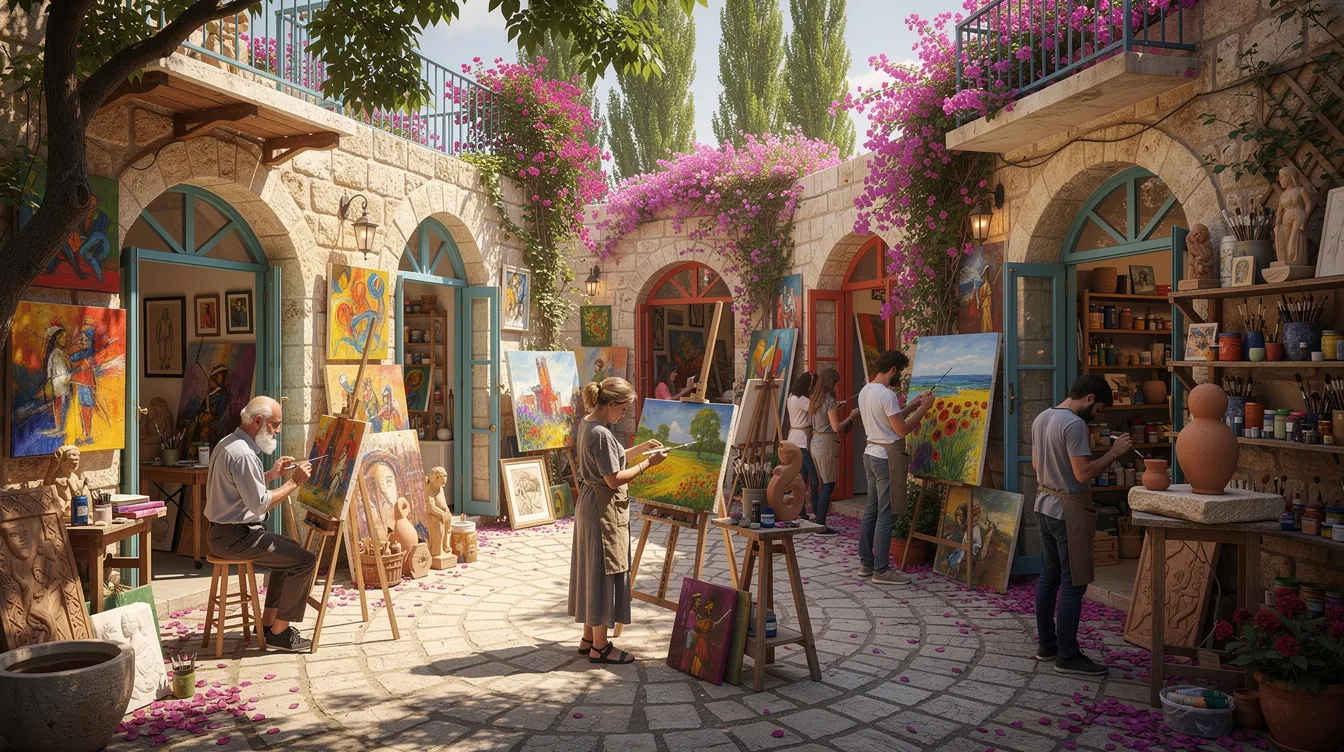
Art flourishes here with a blend of tradition and experimentation. Studios occupy vaulted Ottoman-era rooms. Some artists work with silver to craft ritual objects; others splash pomegranates and fig leaves across canvas in saturated reds. Micro-calligraphers shape entire psalms into the curves of a Hamsa, while glassblowers capture Galilee sunsets in translucent bowls. Many studios are family-run, and if you linger, you’ll often be invited to watch a demonstration or hear the origin story of a style.
Part of the appeal is conversation. On a recent visit, I stepped into a modest gallery to escape a misty drizzle. The painter, apron smudged in ultramarine, offered tea and explained how the town’s winter fog softens edges, pushing her to layer colors slowly. Across the lane, a jeweler let my group peer through a loupe to see filigree knots so fine they looked like lace. You leave with more than a souvenir; you carry a thread of someone’s craft and patience.
Local Artists and Their Influence
The Artists’ Colony grew from a post-independence influx of creatives attracted by cheap studios, light, and the town’s contemplative pace. Their influence is visible in how spiritual motifs have entered the visual language of modern Israeli art. Painters riff on pomegranate seeds as metaphors for deeds; sculptors turn Hebrew letters into flowing forms that suggest both words and wind. Some maintain diaspora techniques brought from Morocco, Yemen, or Eastern Europe, marrying them to local stone and story.
The effect extends to music, where ensembles borrow klezmer lines and lace them with Galilee folk rhythms. Summer evenings often bring informal performances in courtyards, and gallery openings can feel like neighborhood gatherings. While shopping, ask about the process. Micro-calligraphy, for example, is not printed; it’s hand-lettered with patience and magnification, and a single piece can take weeks. That awareness deepens appreciation and helps you choose works that reflect both eye and heart.
Culinary Delights in Safed
Mountain towns have a way of turning meals into moments. Breakfast might be a plate of olives and tomatoes bright with lemon, alongside warm bread and local cheese. Lunch can be simple hummus dressed with zataar and a hard-boiled egg, then a sweet pastry and cardamom-scented coffee to push you up the next flight of steps. Fridays transform the streets as shoppers build Shabbat menus and bakeries pour out challah and cinnamon scent.
Local dairies shape the region’s brined cheese known as Tzfatit cheese, which appears in salads, pastries, and warm sandwiches. Food here often leans rustic: soups that steam up winter windows; herb-studded omelets; and savory pastries layered with butter and flake. In colder months, a bowl of Yemenite soup or a platter of kubbeh in beet broth warms hands and spirits after a morning of gallery-hopping.
Must-Try Dishes and Local Eats
Start with simple street fare. A fresh laffa spread with hummus and amba makes an ideal walking lunch. Seek out bourekas stuffed with cheese or mushrooms; vendors often slide them from the oven to your bag still crackling. For a local touch, taste Tzfatit cheese baked in a skillet with tomatoes and herbs, scooped up with bread. Sweet tooths should hunt for rugelach or a slice of honey-drenched pastry to pair with strong coffee.
Markets and small groceries stock fine Galilean olives, pomegranate syrup, and spice mixes that travel well. If you’re self-catering, ask a cheesemonger how they prefer to serve their brined cheeses at home. They might suggest a quick pan-sear with oregano or a salad of cucumbers, mint, and lemon. Many eateries are family-run, and a brief chat can turn lunch into a mini-lesson on regional flavors.
On Fridays, arrive early to avoid lines and to catch hot bread as it leaves the oven. Some stalls may close before sundown for Shabbat, so plan your snacking window. In summer, cool down with lemon-mint granita; in winter, wrap cold fingers around sweet, spiced tea and savor the view from a lookout bench while the town exhales into evening.
Visiting Safed: Tips and Recommendations
Getting here rewards those who like a bit of a climb. Roads wind into the Upper Galilee, and the uphill approach offers a slow reveal of terraced roofs and mountain air. Driving from the central coast takes a few hours depending on traffic, and buses connect via regional hubs. If you’re arriving by car, expect narrow lanes and limited parking in the historic core. Many visitors park in designated lots uphill and walk down into the Old City.
Weather shifts with altitude. Summers are warm but less muggy than the lowlands, and evenings often require a light layer. Winters can be chilly, occasionally misty, and sometimes even dusted with snow. Shoes with good grip help on polished stone, and a day bag with water, sun protection, and a shawl for synagogue visits keeps you prepared. Galleries and workshops usually keep daytime hours, with some closing for mid-afternoon breaks or early on Fridays.
Best Times to Visit Safed
Spring wraps the hills in green, wildflowers burst from stone seams, and temperatures are kind to walkers. Early summer balances long days with cooler mountain nights. Late summer can be lively with outdoor music and street performances that fill courtyards after dusk. Autumn brings clarity to the air, drawing photographers and hikers. Winter strips distractions, inviting deeper dives into study halls, quiet galleries, and steaming bowls of soup between rain showers.
Shabbat changes the tempo. By Friday afternoon, shops begin to fold, and the atmosphere turns contemplative. It’s a beautiful time to experience candlelight services, but plan meals and errands accordingly. Dress modestly when entering houses of worship; a scarf or cardigan does the trick for shoulders and arms, and longer skirts or pants are appreciated.
For a smooth visit, a few practical habits help:
- Start walks early to enjoy cooler air and softer light.
- Carry cash for small purchases; some studios prefer it.
- Ask before photographing people, workshops, or interiors.
- Wear layers; mountain weather shifts quickly, and layered clothing keeps you comfortable.
- Build in pause time for lookouts and conversations; the best moments rarely appear on a map.
Guided tours can enrich your time with context, but wandering on your own rewards curiosity. Let an alley choose you, follow the sound of a clarinet, and save space in your bag for a small piece of art or a bundle of spices. This mountaintop town meets you where you are, whether you come to study, to sketch, or simply to breathe deep and watch the sky turn rose over ancient stone.