From the curve of the Niger River to the edge of the Sahara, the Songhai Empire stitched together markets, ideas, and peoples into a continental powerhouse. Centered on Gao and radiating out to fabled Timbuktu, it mastered river and desert alike to command trade and scholarship. Its rulers blended pragmatism with vision, building armies, tax systems, and schools that reshaped West Africa. This is the story of rise, brilliance, and hard lessons learned.
💡 Key Takeaways
- At its height, the Songhai Empire controlled significant trade routes across West Africa.
- The empire’s military comprised 30,000 infantry and 10,000 cavalry, making it a formidable force.
- The fall of the Songhai Empire was marked by the Moroccan invasion in 1591, leading to its absorption into the Moroccan Empire.
Overview of the Songhai Empire
At the heart of West Africa’s riverine plain, Gao stood as the political and commercial anchor that made long-distance exchange possible. Sitting on the Niger Bend, Gao linked fertile farmlands to Saharan caravan stations, allowing merchants to move goods between forests and Mediterranean coasts. Just upstream, Timbuktu flourished as a meeting place of scholars, traders, and artisans whose work echoed far beyond the desert’s edge.
The Niger River was the empire’s great highway. Canoes and barges ferried grain, livestock, and people, enabling rulers to project authority quickly across vast distances. When historians describe the reach of the Songhay state, they are referring to a political machine that synchronized desert caravans with river fleets, urban markets with floodplain farms. In this choreography of movement lay both power and vulnerability.
Founding and Expansion
Songhay-speaking communities had long clustered around Gao, already a vibrant trading town by the eleventh century. As the neighboring Mali Empire weakened in the fourteenth and fifteenth centuries, local leaders asserted independence, shaping a kingdom with Gao at its core. The Sunni dynasty consolidated this power, building on river commerce and strategic alliances with pastoralists and urban elites.
Territorial growth accelerated in the mid-fifteenth century as Gao’s rulers seized control of caravan gateways and river ports. Key victories folded the Inland Niger Delta’s rich farmlands and fishery into the state. Ports such as Timbuktu and Djenné, once contested by Tuareg and urban oligarchies, were brought into a loose but effective administrative orbit, turning a regional kingdom into a genuine continental player.
Key Figures in the Songhai Empire
Great states turn on decisive individuals, and the path from ambitious kingdom to superpower was shaped by two towering figures. Sunni Ali, remembered for audacity and relentless campaigning, secured the arteries of wealth that fed the state. His successor, Askia Muhammad, rearranged those gains into a durable system of law, taxation, and scholarship that knit diverse communities together.
Chronicles compiled in later centuries, such as the Tarikh al-Sudan, present contrasting portraits of these rulers. The military founder appears as a storm that broke old alignments; the reformer emerges as a gardener who pruned, trained, and irrigated institutions. Between them lies the template that sustained the Songhay order during its prime.
Sunni Ali’s Reign
Sunni Ali captured Timbuktu in 1468 and Djenné soon after, silencing rival claims to the river corridor. He exploited the Niger’s curves with a fleet of war canoes that could rush troops to sieges or ambush hostile forces. This river strategy let him dissolve the advantage of desert-ride raiders and ensure constant supply to his moving armies.
His approach to governance was pragmatic. Local merchant councils were outflanked but not eliminated, and pastoral clans were made partners in frontier defense. Sunni Ali also cultivated an image of overwhelming presence. Rapid marches, surprise attacks, and staged displays at river crossings projected an aura that often compelled surrender before a battle line formed.
Askia Muhammad’s Contributions
In 1493, Askia Muhammad consolidated power after a succession struggle and immediately set about building a state that could outlast a single ruler’s charisma. He appointed provincial governors with responsibility for tax collection, defense, and arbitration. He strengthened the judiciary by empowering qadis to apply Islamic law in cities while allowing customary law to guide rural communities, a hybrid that cut down disputes and boosted trade confidence.
Askia Muhammad undertook a celebrated pilgrimage to Mecca, which affirmed his legitimacy in the wider Islamic world and helped attract scholars and artisans to Gao and Timbuktu. On his return, he standardized market practices: measures were calibrated, imposts clarified, and river tolls regularized. Grain reserves and caravan depots were cataloged, and trusted officers audited revenues, limiting leakage that had plagued earlier conquests.
Economic Prosperity: Trade Routes and Resources
Prosperity flowed from the empire’s command of both caravan trails and river ports. The bend of the Niger let administrators pivot between savanna farms and Saharan entrepôts, linking rainforest goods to Mediterranean markets. At its height, the state monitored camel trains threading through Taghaza and Walata and barges shuttling between Gao, Timbuktu, and Djenné. This interlock made the kingdom more than a territory; it was a logistics system refined for profit.
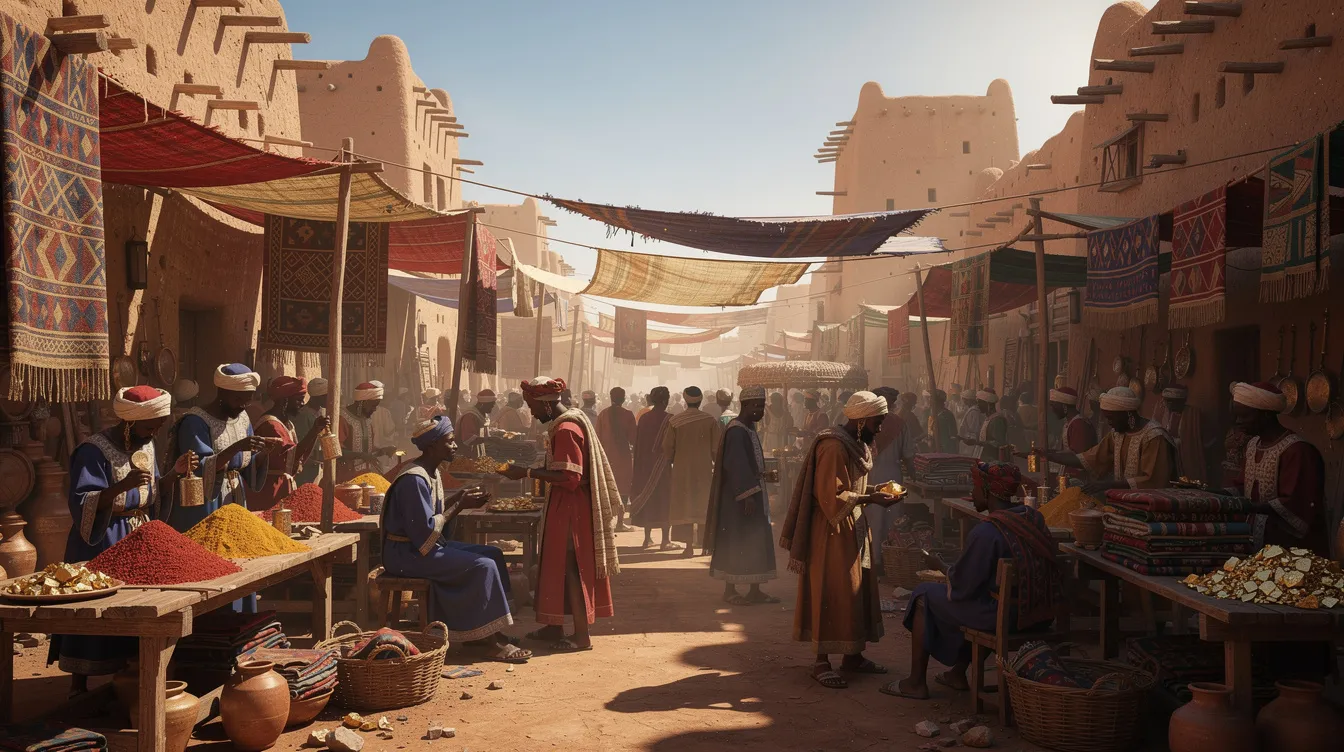
The lifeblood of that system was exchange. Desert salt, forest products, and Sahelian grain met in bustling markets where brokers matched demand with supply. Chroniclers noted bustling docks in Gao and sandy forecourts in Timbuktu where caravans were taxed, inspected, and set back on their way, receipts tied to bales as they traveled another leg of the journey.
- Gold from the southern forests and river gravels moved north by canoe and camel, financing state craft and scholarship.
- Salt mined in Saharan pits at Taghaza entered cities as staple and currency, stacked in bars that held value well.
- Kola nuts, prized as stimulant and social gift, traveled from forest belts to Sahelian markets.
- Textiles and copper arrived from North Africa, traded alongside glassware, paper, and books.
- Livestock, grains, and fish from floodplains fed cities and marching columns, stabilizing prices after poor rains.
To visualize the flow, imagine Gao as a customs gate and river port where goods were weighed, duties paid, and barges queued for departure. Caravan masters preferred predictable fees to fickle tolls, so administrators published schedules, kept scales honest, and protected travel partners. These simple assurances drew more trade through official channels, fattening treasuries and underwriting garrisons.
Markets thrived on trust. Judges adjudicated merchant disputes and notarized credit arrangements, while market inspectors checked measures of grain and cloth. Builders improved quays and erected shaded stalls, allowing commerce to continue during scorching seasons. By aligning taxes with transit speed and infrastructure quality, policymakers gave traders a reason to choose the river towns under imperial protection.
Such choices explain how the Songhai Empire could control significant routes across West Africa. Strength on the river meshed with influence in the desert, and with each safe passage completed, the state’s reputation amplified, attracting more caravans into its orbit.
Cultural Achievements and Education

Commerce paid for classrooms, and Sahelian cities turned trade surpluses into centers of learning. Scholars debated law and philosophy, botanists recorded remedies, and astronomers tracked seasons crucial for farming and navigation. Calligraphers copied texts in elegant Maghribi script, while book dealers stocked works from Cairo, Fez, and Andalus, adapting them to local needs.
Music and oral history flourished too. Court bards preserved dynastic memory, while urban families passed down artisanal secrets for tanning leather, dyeing indigo, and forging tools. Architecture blended mud-brick engineering with wooden toron beams, creating airy, high-walled mosques suited to desert climates and communal worship.
Timbuktu as a Cultural Hub
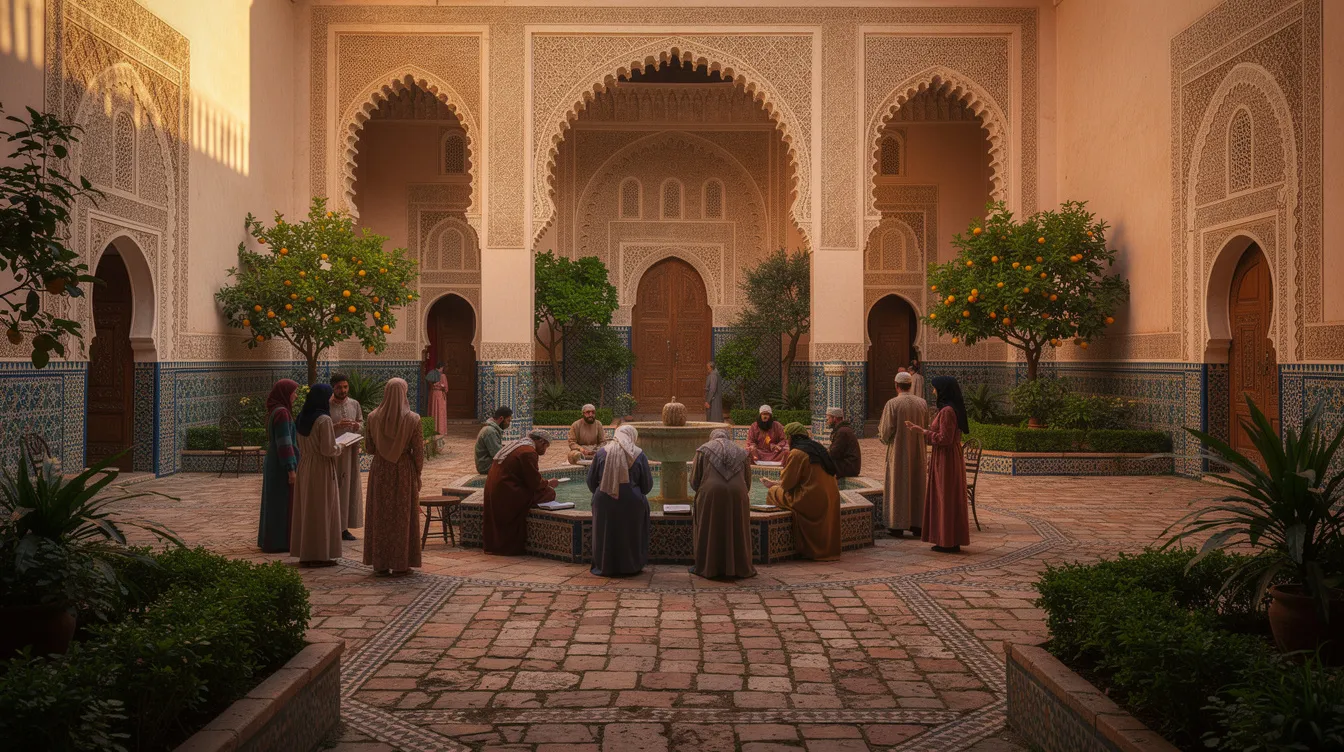
At the apex stood Timbuktu, home to the Sankore scholarly complex and networks of private libraries. Teachers lectured in courtyards, students copied texts under the shade, and debates spilled into markets where philosophy mingled with price haggling. The city’s schools attracted legal minds who standardized contracts and advised governors across the realm.
Among the luminaries was Ahmed Baba, a jurist whose writings shaped legal thought well beyond the Niger. Families safeguarded manuscripts on theology, grammar, and science inside timber-framed chests, many annotated in the margins by generations of students. This manuscript culture preserved not just imported wisdom but local observations on the river’s floods, soils, and crops that gave scholarship a lived, Sahelian texture.
Gao, though political, also became a cosmopolitan crafts center. Boat-builders perfected long canoes for cargo and war. Farmers and fishers coordinated planting and netting with scholars who tracked lunar months and river stages, a collaboration that raised yields and stabilized urban food supplies.
Military Strategies and Conflicts
Armies enforced the tax code and secured the trade arteries that paid for it. Chroniclers describe a force of 30,000 infantry and 10,000 cavalry, a combined-arms machine built for speed on open savannas and for shock at river crossings. Infantry with spears, bows, and shields held ground while mounted units hammered flanks, and a flotilla ferried troops along the Niger to outpace desert raiders.
Commanders cultivated mobility. Horses stabled near river ports could be fed with boatloads of fodder, keeping cavalry fresh for long pursuits. War canoes shadowed march routes, bringing grain and replacements, turning the waterway into a moving warehouse that kept sieges short and patrols frequent.
Conflicts spanned many frontiers. The empire contested Mossi raids from the south, countered Tuareg pressure around desert gateways, and checked Mali’s attempts to reclaim lost towns. In the east, military expeditions projected into Air and Agadez to discipline caravan corridors. Each campaign paired a swift strike with negotiated settlements that reinstalled compliant elites and restored toll collection.
Skilled leadership made these tactics more than maneuvers. Judges traveled with commanders to settle disputes, tax officials recorded spoils to prevent theft, and quartermasters rationed grain to avoid price spikes in war zones. The Songhai Empire thus fought with accountants and jurists as well as swordsmen, translating battlefield gains into administrative order.
Decline and Fall of the Songhai Empire
Strength invites rivalry, and complex systems fray under repeated stress. After the long, prosperous reign of Askia Daoud in the sixteenth century, succession disputes multiplied. Senior commanders and provincial governors carved out fief-like domains, channeling revenues to their own followings, while court factions in Gao undermined unity. The river still flowed, but fewer barges carried taxed grain toward the capital.
External pressures compounded internal fractures. Control over desert salt pits grew uncertain, elite households disagreed over appointments, and scholars resented interference by soldiers in city affairs. Rumors of gunpowder-armed forces to the north reached river towns, unsettling a military system still anchored in archers, spearmen, and horsemen.
The Impact of Civil Wars
Civil wars were corrosive not just for the blood they drew but for the habits they taught. Governors learned to withhold troops until promises were made; tax collectors hedged bets by storing revenue far from the capital. Merchants reverted to private escorts, paying less in official tolls and more to freelance protectors. Every workaround kept trade alive but starved the center of predictable income.
Scholars fled fractious cities for quieter towns along the river and into the countryside, thinning the advisory corps that once improved judgments and contracts. Laws still existed, but enforcement splintered as commanders grew independent and markets improvised. By the time unity could be attempted, the state had lost the speed and trust that once defined it.
Moroccan Invasion and Its Consequences
In 1591, a Moroccan force under Judar Pasha marched south with arquebuses and cannon. At the Battle of Tondibi near Gao, imperial cavalry charged bravely but could not break dense gun lines. The clash was decisive: Gao was occupied, Timbuktu submitted soon after, and the river’s main ports fell into the hands of a northern-appointed garrison.
Administration shifted to a Moroccan pashalik that tried to skim caravan profits while ruling through local elites. Yet gunpowder victory did not translate into easy governance. Caravans sought safer detours, and villages resisted unfamiliar tax demands. Remnant Songhay leaders retreated downstream to Dendi, waging stubborn but ultimately waning resistance. Absorption into the Moroccan sphere ended the imperial phase, even as local polities and trading families adapted to changed circumstances.
Legacy of the Songhai Empire
The empire’s legacies are stitched into West Africa’s political and cultural fabric. Administratively, it demonstrated how a river-and-caravan economy could be governed through layered jurisdictions, learned judges, and audited treasuries. That template influenced successor states that balanced Islamic legal institutions with local custom, especially in multiethnic markets where trust was the most valuable currency.
In the arts and sciences, the manuscript culture of Timbuktu seeded a regional memory of scholarship that still inspires conservation and research today. Architecture in the Sahel reflects that same practical brilliance: mud mosques anchored by wood beams, courtyards tuned to wind and heat, and markets aligned with seasonal rhythms. Gao’s story as a political port city and Timbuktu’s as a luminous classroom remind us that capital and knowledge thrive together.
Trade geography offers another lesson. By synchronizing camel caravans with river fleets and pegging tax policy to speed and safety rather than mere exaction, rulers built a self-reinforcing network. Farmers, fishers, smiths, and scholars all found roles in a system where prosperity rose with predictability and where law gave commerce a language everyone understood.
The Songhai Empire’s story also cautions against complacency. Innovation in logistics could not outlast complacent leadership, corrosive factionalism, and failure to adapt to gunpowder. Yet its achievements in administration, education, and trade remain an enduring reference point. When we trace the curves of the Niger and step into the sandy courtyards of Sahelian towns, we still follow paths set down in that remarkable age, paths that continue to connect people, ideas, and opportunity.