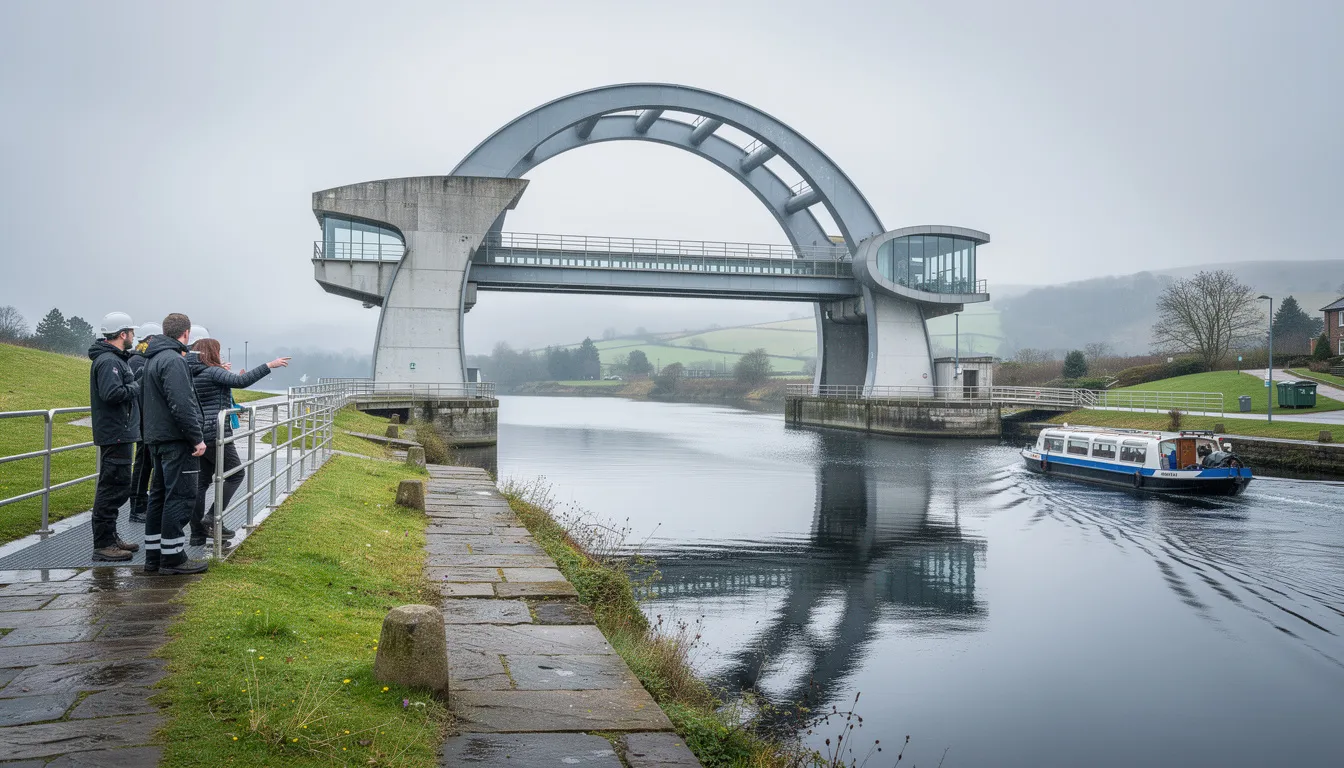
Graceful, silent, and impossibly clever, the Falkirk Wheel rewrites what a canal junction can be. This rotating boat lift near Falkirk reconnects central Scotland’s historic waterways with a flourish of modern engineering. More than a landmark, it is living infrastructure that works as beautifully as it looks. If you want proof that the falkirk wheel a scottish innovation still inspires the world, watch it turn.
💡 Keys Takeaways
- The Falkirk Wheel is the only rotating boat lift of its kind in the world.
- It connects the Forth and Clyde Canal with the Union Canal, elevating boats 24 meters.
- Opened in 2002, it has become a key tourist attraction, drawing over a million visitors annually.
About the Falkirk Wheel
The Falkirk Wheel is a sculptural machine that links the Forth & Clyde Canal with the Union Canal. By rotating two water-filled caissons, it lifts boats by 24 meters in a smooth, five-minute turn. That motion restores a through route across central Scotland without the footprint of dozens of traditional locks.
Its form is iconic, often likened to a giant propeller or a Celtic double-headed axe, but every curve works hard. The caissons, arms, gears, and bearings are all tuned for balance and efficiency, making the falkirk wheel a scottish innovation that feels inevitable once you see it in action.
What is the Falkirk Wheel?
At its heart, the Falkirk Wheel is a rotating boat lift with two opposing gondolas, called caissons. Each caisson carries boats in a chamber of water. Because of Archimedes’ principle, a boat displaces its own weight in water, so each caisson always weighs the same whether it holds one narrowboat or several. That perfect balance is the secret to the Wheel’s elegance and thrift.
The structure raises boats from the lower Forth & Clyde Canal to an elevated aqueduct. From there, a short passage and two additional locks complete the climb to the Union Canal. In the opposite direction, the process runs just as smoothly. It is the only rotating boat lift of its kind worldwide, and the falkirk wheel a scottish innovation people search for when they want an example of functional beauty.
Engineering and Design
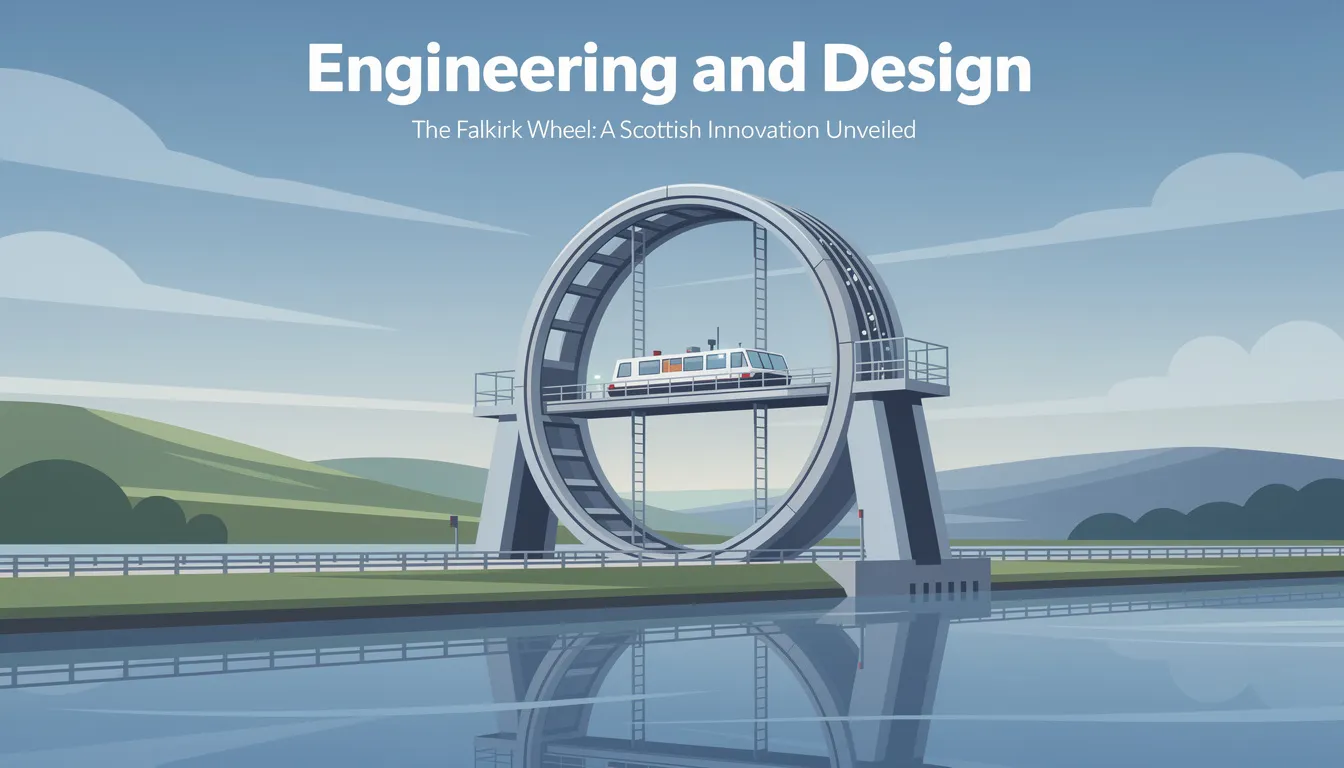
Everything about the Wheel is designed for equilibrium. The two caissons sit at the ends of matched arms, turning together on a central axle. Because their masses are equal, the system remains balanced throughout the rotation. The drive needs only modest power to overcome friction and initiate motion, since gravity is not pulling one side down more than the other.
A precise control system governs valves and gates that seal each caisson, maintaining water levels within millimeters. Massive ring gears and pinions synchronize the arms so the caissons stay perfectly level. The bearings are engineered to carry huge loads with minimal resistance, ensuring a rotation that feels almost effortless. This is the falkirk wheel a scottish innovation distilled into physics you can watch.
How Does It Work?
Think of a perfectly balanced see-saw that turns in a circle. Here is the simplified sequence:
- Boats enter each caisson. Water levels are equalized, and watertight gates close.
- The control system checks balance. Because a boat’s mass equals the water it displaces, each side weighs the same.
- Electric motors engage through large gears, overcoming friction to start the rotation.
- The Wheel turns 180 degrees in about 5 minutes, keeping each caisson level.
- Gates open, and boats exit onto the aqueduct or the lower canal.
That is the whole magic. The lift expends only a small amount of energy, because the machine is never fighting an unbalanced load. You see efficiency, control, and balance translating into motion, making the falkirk wheel a scottish innovation that school groups and engineers both admire.
The design also anticipates Scotland’s weather. Seals, bearings, and motors are specified for wet, windy conditions, with sensors to pause operations if gusts rise beyond limits. The structure’s geometry sheds water and dissipates loads, while maintenance teams monitor tolerances that keep rotations buttery smooth season after season.
Historical Significance
For more than a century, Scotland’s lowland canals were the arteries of trade and travel. Over time, roads and rail reduced canal traffic, and sections fell into disuse. The original staircase of locks that once linked the Forth & Clyde to the Union Canal was removed, severing a continuous water route across the heart of the country.
The Wheel changed that story. Conceived within the Millennium Link project, it reopened a navigable corridor between Scotland’s east and west coasts and did so with flair. When it opened in 2002, it symbolized a modern Scotland proud of its heritage yet eager to solve old problems with new ideas. Today it stands as the falkirk wheel a scottish innovation that honors canal history while writing a fresh chapter.
Impact on Scottish Canals
The impact runs deeper than a dramatic lift. The Wheel reanimated a network, inviting boaters back to routes that once carried coal, timber, and grain. It pulled investment into marinas, towpath improvements, and community spaces, nurturing a culture of active travel and waterside life.
- Cultural revival: Canal festivals, art installations, and school programs now thrive along the banks.
- Economic boost: Hospitality, boat hire, and guiding businesses grew as visitor numbers rose to over a million annually.
- Conservation: Restored locks, cleaned channels, and biodiversity projects support wildlife and healthy waterways.
Equally important is the Wheel’s educational reach. Teachers use it to explain buoyancy, torque, and conservation to students who can see principles at work. For families, the experience turns engineering from textbook theory into a moving, humming reality that is as memorable as it is instructive. That blend of learning and wonder keeps the falkirk wheel a scottish innovation at the center of Scottish canal storytelling.
Visitor Information
The Falkirk Wheel sits between Glasgow and Edinburgh, just outside the town of Falkirk. You can drive, take a train to Falkirk High or Grahamston then ride a local bus or taxi, or arrive on foot or bike via the towpaths. On site, you will find a visitor center, café, gift shop, boat trip boarding, and broad viewing terraces.
Most visitors come to watch a rotation up close. The best vantage points line the basin below and the aqueduct above. Arrive early or late in the day for softer light and fewer crowds. Checks on the day’s schedule help, as operations can pause during high winds or for planned maintenance. If you want to see the falkirk wheel a scottish innovation working at full drama, time your visit before a boat trip departs.