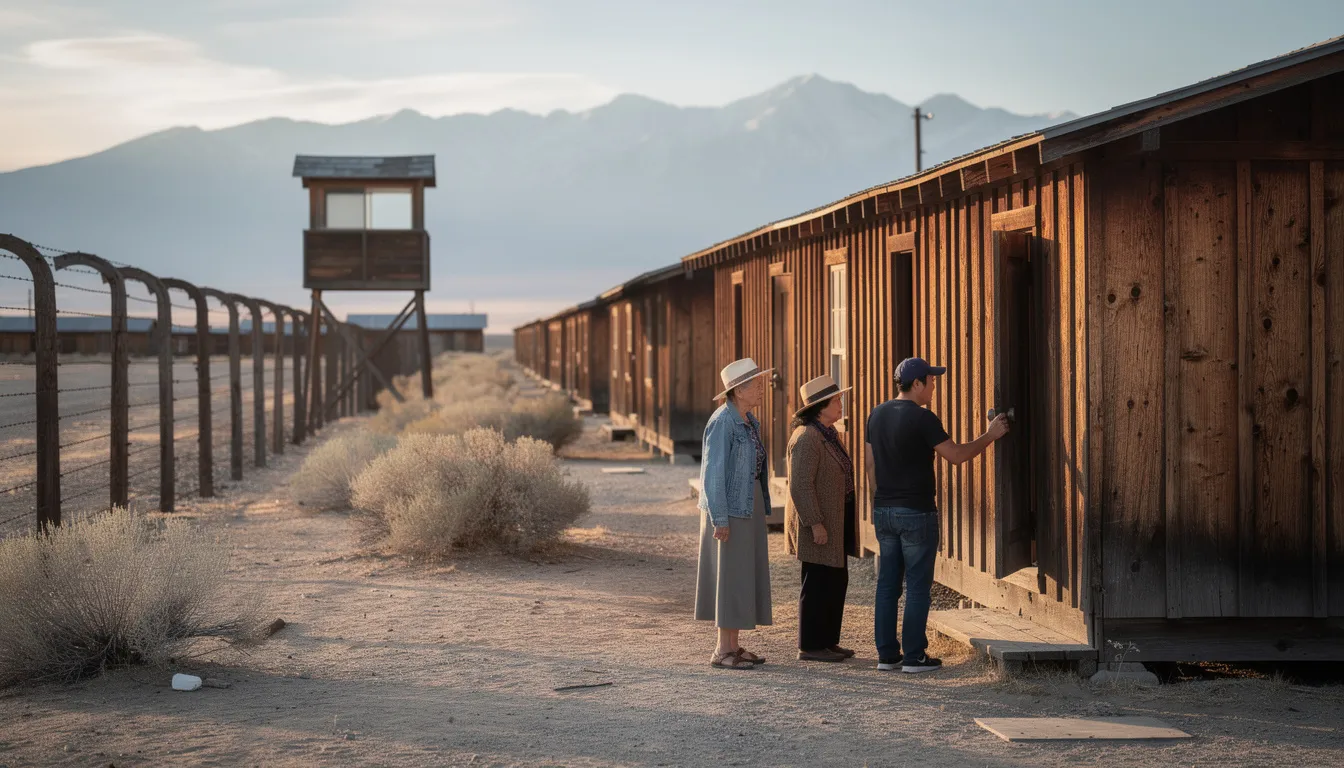
Set against the granite wall of the Sierra Nevada, Manzanar asks visitors to look, listen, and remember. Here, families once lived behind barbed wire as dust storms blew through hastily built barracks. Today, the stories are still present in the wind, the rock gardens, and the quiet of the cemetery. If you want history that speaks both to the past and the present, this is where to start.
💡 Keys Takeaways
- Manzanar was one of ten internment camps for Japanese Americans during WWII.
- The site is now a National Historic Site managed by the National Park Service.
- Over 120,000 Japanese Americans were forcibly relocated during the war.
Manzanar National Historic Site sits in California’s Owens Valley, between the Sierra Nevada and the Inyo Mountains, on land that once held a World War II incarceration center. It is a place of learning and reflection that documents a chapter of American history often skipped over in textbooks. Exhibits, reconstructed buildings, and a self-guided auto tour help visitors understand daily life for the people who lived here.
The site is managed by the National Park Service, which preserves the landscape and curates powerful exhibits. Beyond facts and timelines, the story comes alive through oral histories, family photos, and the details of ordinary days lived in extraordinary circumstances. You can stand inside a reconstructed barracks room, touch the wood bunks, and feel how thin the line was between privacy and exposure.
Personal testimonies give the visit heart. A teenager remembered stuffing rags into cracks to keep out the dust. A grandfather taught his grandson to rake a rock garden the way he learned behind the fence. A nurse recalled midnight births in the camp hospital. These threads pull you close to people whose lives were rearranged by fear and policy.
For travelers planning an Eastern Sierra road trip, the manzanar national historic site is an essential stop. It is not a quick photo-op. Plan time to slow down, read, listen, and walk. The experience stays with you long after you drive away.
History of Manzanar
After the attack on Pearl Harbor in 1941, fear and wartime prejudice set the stage for a drastic policy. In early 1942, President Franklin D. Roosevelt signed Executive Order 9066, authorizing the forced removal of Japanese Americans and Japanese immigrants from the West Coast. Families had days or weeks to sell property, store belongings, and pack only what they could carry.
More than Over 120,000 people of Japanese ancestry were uprooted and confined in a network of ten large camps stretching from California to Arkansas. Manzanar was among the first to open. Buses and trains brought men, women, and children to a windy, high-desert plain near the town of Independence. Rows of tar-paper barracks went up quickly, with communal latrines, mess halls, and guard towers.
Daily life was structured but improvised. Internees created schools, newspapers, churches, sports leagues, and social clubs. They worked as teachers, farmers, medical staff, carpenters, and cooks for a small wage. Dust storms blew fine, alkaline sand through walls and windows. Winters were cold, and summers were hot. Many people remember the taste of canned peaches in syrup as a rare treat after a long shift in the mess hall.
Manzanar’s story includes resilience and conflict. Some residents enlisted in the U.S. Army, serving with distinction while their families remained incarcerated. Others protested curfews, wages, and the indignity of life under surveillance. An episode of unrest in late 1942 underscored the tension and trauma of confinement. Through it all, people did what they could to build normalcy: they made baseball fields, planted shade trees, and tended rock gardens that still surface across the site.
Personal stories are central to understanding this history. Imagine arriving as a high school senior, your diploma delayed because your school records are now behind a fence you cannot cross. Picture a young mother warming bottles next to a coal stove in a barracks shared with other families. Consider a gardener who designs a koi-less pond edged with granite he hauls by hand, a quiet act of beauty and control in a place defined by loss.
When the war ended, families left Manzanar to rebuild their lives with little more than a train ticket and a small stipend. Many returned to find homes and businesses gone. Years later, former incarcerees and allies pressed for public recognition and preservation. Their advocacy led to the designation of the manzanar national historic site, ensuring that the lessons of this period are not forgotten.
Visitor Information
A visit to manzanar national historic site rewards those who plan a few simple details. The landscape is open and the stories are deep, so give yourself time to explore the visitor center, walk the grounds, and drive the broader site tour. Spring and fall often bring comfortable temperatures and clearer air, while summer can be very hot and winter can be cold and windy.
Expect a contemplative experience. Photography is welcome, especially at the cemetery monument and rock gardens, but be thoughtful and respectful. If you are visiting with children, build in breaks and invite questions. This is a place where curiosity matters.
Location and Access
Manzanar lies along US-395 in the Eastern Sierra, between Lone Pine and Independence, California. The drive itself is part of the experience, with the Sierra wall to the west and desert light shifting across the valley. Parking is plentiful near the visitor center, and the auto tour route circles many key locations around the historic camp.
The site is open year-round, though hours for indoor exhibits can vary by season and holiday. Admission is typically free. Many outdoor areas are flat and accessible, and key buildings include ramps and wide doorways. Check for current conditions with the National Park Service if you have specific accessibility needs, including wheelchairs, strollers, or mobility concerns. The grounds are exposed, so bring water, sun protection, and layers for wind.
Practical tips that help:
- Arrive early for quiet time in the exhibits before peak midday visitation.
- Carry at least one liter of water per person. Shade is limited.
- Wear closed-toe shoes. Sand and small stones make some paths uneven.
- Download or pick up the auto tour guide to enrich stops around the site.
Exhibits and Tours
The visitor center, housed in a historic auditorium building, anchors most visits. It features artifacts, oral histories, and immersive displays that trace removal, transport, and daily life in camp. Reconstructed buildings show how people lived, cooked, and found community within rigid conditions. Allow 60 to 90 minutes inside, then take time outdoors for a fuller sense of place.
Highlights not to miss:
- Block 14 Barracks and Mess Hall: step into furnished rooms with bunks, coal stoves, and personal touches.
- Latrine Building: a stark reminder of lost privacy and the communal reality of camp life.
- Guard Tower and Sentry Posts: physical symbols of surveillance and control.
- Cemetery Monument (often called the “Soul Consoling Tower”): a solemn space for reflection and offerings.
- Rock Gardens and Remnants: hand-built landscapes that speak to creativity and care.
The self-guided auto tour stops at the cemetery, hospital area, orchard remnants, and residential blocks. Interpretive signs add context, and the silence between stops lets the landscape do some of the teaching. If you prefer company, ask at the desk about scheduled ranger talks or brief outdoor programs that may run seasonally.
Educational Programs
Manzanar is a powerful classroom for students and lifelong learners. Ranger-led talks often touch on constitutional rights, wartime decision-making, and the voices of people who lived here. Educators can request materials that align with history and civics standards, and many schools plan visits during spring when weather and schedules align.
Families can turn the site into a shared learning experience. Try this approach: have each person choose one object or photo in the visitor center that resonates. Later, at the cemetery or a rock garden, share why that item mattered. The practice builds empathy and helps younger visitors connect feelings to facts.
Visitation trends reflect the site’s educational pull. In recent years, annual visitation has generally ranged from the tens of thousands into the low six figures, with busiest periods in spring and fall. Weekdays often bring school groups and university classes, while weekends draw road trippers, families, veterans, and Japanese American descendants seeking family history. Mornings tend to be quieter than afternoons.
Significance of the Site
The power of manzanar national historic site is twofold. It preserves a specific place where families built lives inside a fence, and it challenges visitors to think about civil liberties during times of crisis. The buildings, artifacts, and stories add depth to dates and legal language, turning abstract rights into daily routines like lining up for meals or waiting out a dust storm.
Memorial spaces carry much of this weight. The cemetery monument feels personal, with origami cranes, pebbles, and strings of prayer beads often left in quiet tribute. The rock gardens, many uncovered by archaeologists and volunteers, show how people used skill and artistry to shape small sanctuaries. These are not grand gestures. They are the everyday work of dignity.