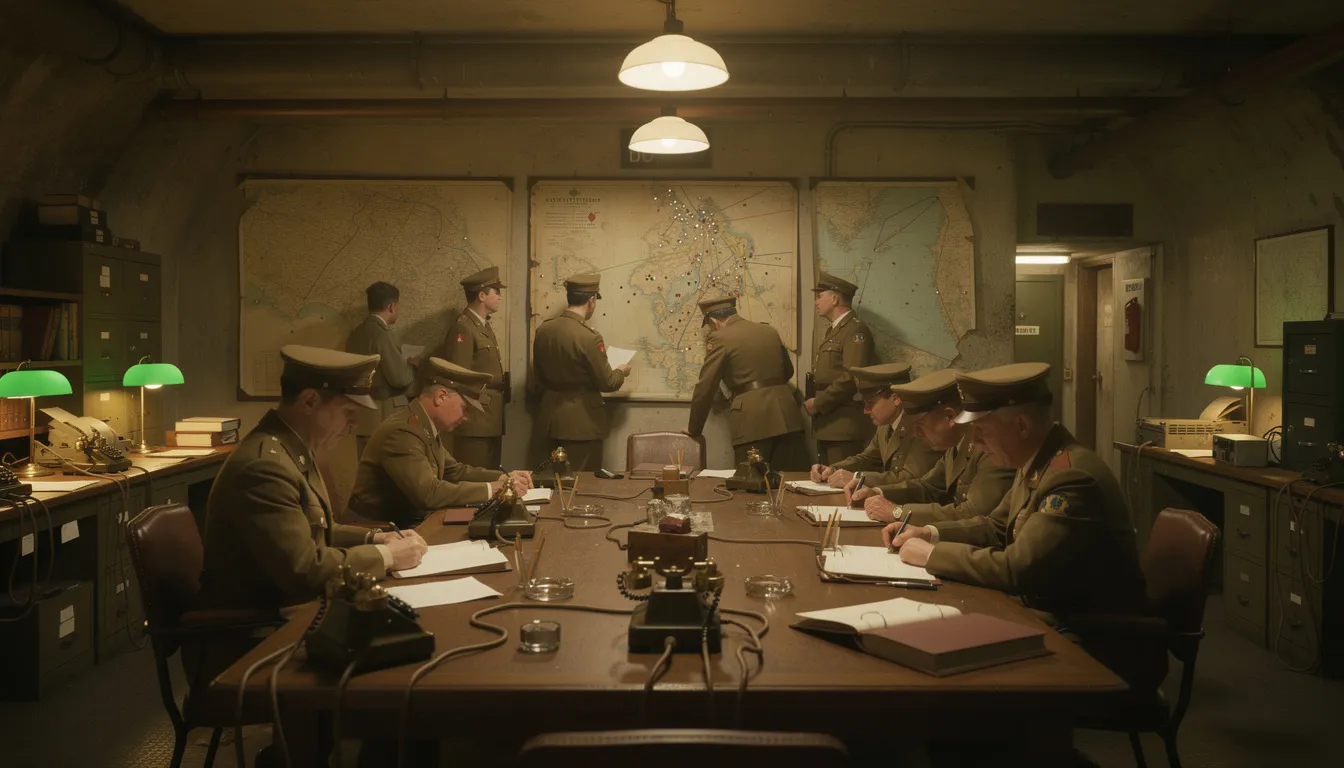
Step beneath Whitehall and step back in time. The churchill war rooms are a preserved underground bunker where Britain directed World War II, still humming with the urgency of 1940. You walk past maps peppered with pinholes and telephones that once rang with life-or-death decisions. It is immersive, moving, and packed with stories that make history feel close enough to touch.
💡 Keys Takeaways
- Established in 1984, the Churchill War Rooms are part of the Imperial War Museum.
- The site includes both the Cabinet War Rooms and the Churchill Museum.
- More than 1 million visitors explore the war rooms annually.
Inside the Churchill War Rooms
Hidden beneath the government offices of Whitehall, the churchill war rooms form a maze of offices, sleeping quarters, and strategy spaces that kept Britain’s leaders working during the Blitz. This is not a replica. Rooms are preserved with wartime pencils still in trays and maps layered with colored threads that tracked enemy movements in real time.
Today, the site is both a historic time capsule and a modern museum. Established in 1984 and now part of the Imperial War Museum, it welcomes more than 1 million visitors each year. You can explore the Cabinet War Rooms where crucial decisions were made and step into the Churchill Museum, which unpacks the Prime Minister’s life, leadership, and complicated legacy.
What strikes many visitors is the atmosphere. Lighting is low, corridors are tight, and the hum of period broadcasts is never far away. It feels as if the last switch was just flipped off, and the staff might return at any moment.
History of the Churchill War Rooms
Construction began on the bunker shortly before the outbreak of World War II. By late 1939, the Cabinet War Rooms were ready for use and quickly became the nerve center of Britain’s war effort. Ministers, military chiefs, and civil servants gathered here to coordinate strategy, analyze intelligence, and communicate with Allied leaders.
When victory was secured in 1945, staff walked out and locked the doors. Many rooms were left almost untouched for decades. This accidental preservation allowed curators to reveal a remarkably authentic slice of wartime life when the rooms formally opened to the public in 1984. For historians, the churchill war rooms capture the logistics and psychology of command under pressure with rare fidelity.
The Significance of the War Rooms
The bunker was more than a safe space. It was a fully functioning headquarters that made command resilient during air raids. The Cabinet Room brought the Prime Minister together with chiefs of staff to debate and set policy in meetings that could alter the course of the war. The Map Room maintained a constant watch on global operations, updating information around the clock. Its walls are still plastered with charts, punch marks, and pins.
Scholars often highlight the War Rooms as an early model of integrated command. Civilian leaders, military planners, typists, and intelligence officers worked side by side, compressing decision making into tight, accountable teams. That model influenced postwar thinking about crisis management and national security.
Famous Figures Associated with the War Rooms
Winston Churchill is the dominant presence here, but the story is bigger than one man. Field Marshal Alan Brooke, Admiral Sir Dudley Pound, and Air Chief Marshal Charles Portal were among the senior commanders who gathered at the table to shape operations. General Hastings Ismay served as Churchill’s Chief of Staff, helping translate political aims into military plans.
Behind the scenes, typists, switchboard operators, meteorologists, and map clerks sustained the machine. Many were young women whose speed and precision under pressure kept intelligence and orders flowing. Clementine Churchill visited frequently, offering support and counsel that Churchill himself credited as vital. Together, they give the rooms a deeply human pulse.
What to Expect on Your Visit
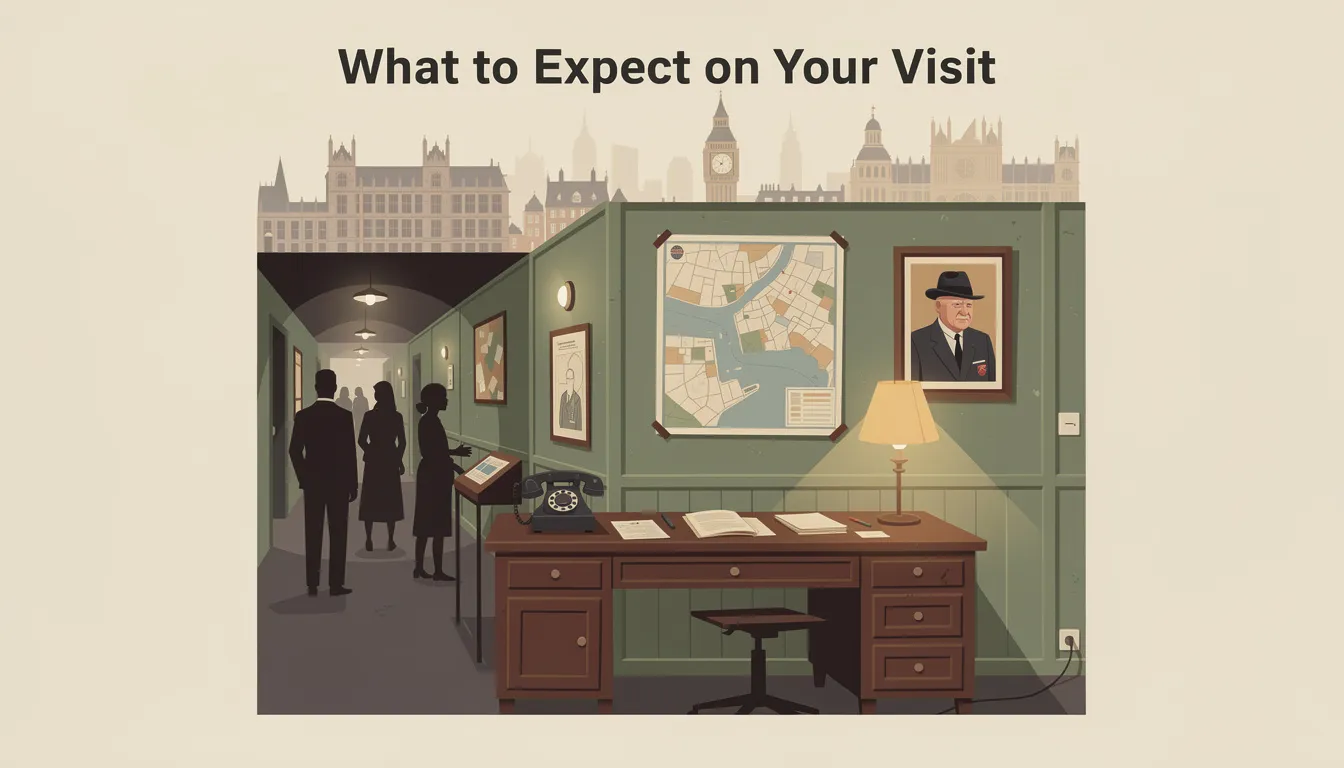
A visit to the churchill war rooms is self-guided through a one-way route that winds past preserved rooms and multimedia exhibits. The atmosphere is immersive, with authentic furniture, wartime signage, and period broadcasts that pull you into the 1940s without feeling like staged theater.
You will move from the Cabinet Room and Map Room into personal spaces like Churchill’s bedroom and the tiny room that housed secure transatlantic calls. Midway, the route opens into the Churchill Museum, a contemporary space that explores Churchill’s childhood, political career, wartime leadership, and postwar years through artifacts, film, and interactive displays.
Exhibits and Displays
Several highlights consistently stand out and are worth taking your time to absorb:
- The Map Room with original wall maps, pinholes, and daily situation boards left exactly as they were on V-J Day.
- The Cabinet Room where ministers met under ceiling reinforcement, with Churchill’s chair facing the long table.
- Churchill’s bedroom and working space, including a simple camp bed and personal items that hint at his relentless schedule.
- The secure transatlantic telephone room, a compact space designed for high-level calls, including conversations with President Roosevelt.
- The Churchill Museum with immersive timelines, speeches, letters, and the famous “siren suits” that became part of Churchill’s public image.
Audio elements enrich these rooms with clips of speeches, first-person accounts, and wartime sounds. If you pause in the Map Room, you can almost hear the scratch of pencils and layered whispers of shift changes. Many visitors find they need a moment to take in the Cabinet Room before moving on. The emotional weight is real.
Tips for Visiting the Churchill War Rooms
Plan for at least 90 minutes and up to two and a half hours if you like to read displays thoroughly. Peak times are late mornings and weekends. Quieter slots are earlier in the morning and late afternoon. Because entry is usually timed, booking ahead helps you avoid queuing and gives you more control over your day in Westminster.
Tickets often include an audio guide with multiple languages, which is ideal for pacing yourself. Guided talks or short briefings may be scheduled on busy days and add useful context, especially for first-time visitors. Photography is allowed for personal use, though tripods and flash are typically not permitted. The on-site café offers light meals and snacks, and the shop is excellent for gifts and World War II histories.
Opening hours generally run during daytime with last entry roughly an hour before closing. Hours and pricing can vary by season and special events. Check the official information on the day you plan to go, especially around bank holidays.
Accessibility and Visitor Information
The museum route is largely step free with lift access, though corridors are narrow and lighting is intentionally low to preserve the atmosphere. Staff are helpful in suggesting quieter paths if you need to pause. Accessible restrooms, seating points, and baby changing facilities are available. If you are sensitive to sound, consider bringing ear protection since some exhibits use audio to recreate wartime conditions.
Practical pointers that make a difference:
- Book a timed slot in advance to reduce waiting and secure preferred times, especially in school holidays.
- Arrive with a fully charged phone or a small battery pack if you plan to use the digital guide features.
- Wear comfortable shoes. The route is not long but you will stand often to read displays.
- Bring a light layer. Temperatures can feel cooler underground compared to outside.
- If visiting with children, set a treasure-hunt goal such as finding Churchill’s door chime or a specific map symbol to keep younger minds engaged.
Visitor services are experienced at handling busy periods. Because the churchill war rooms attract a global audience, expect a mixed crowd and multilingual audio around you. If you prefer a more contemplative experience, morning slots just after opening tend to be calmest.
Why You Should Visit
Few museums give you such a direct line to decision making under pressure. Inside these rooms, history is not abstract. It is a table with scuffed edges, a phone that might ring at any second, and a pin stuck into a map as ships cross a dangerous sea. The churchill war rooms let you stand where strategy became action and where small judgments stacked into world-shaping outcomes.
There is also breadth beyond the bunker. The Cabinet War Rooms ground you in the mechanics of wartime leadership, while the Churchill Museum opens up the personality and contradictions of the man who led Britain through crisis. That pairing makes the site unusually rich. You leave with both the granular detail of how a war was run and the bigger questions about power, character, and responsibility.
Whether you are a London first-timer, a history lover, or a family looking for something different near St James’s Park, this is a rare experience that earns every bit of its reputation. It is practical, poignant, and unforgettable, which is why so many travelers add it to their must-see list year after year.