Walk the sunlit arcades of mission san juan capistrano and you trace the heartbeat of California’s past. Founded in 1776, the landmark blends Spanish colonial craft, Indigenous memory, and lush gardens into one captivating story. From the swallows’ springtime return to the haunting beauty of the Great Stone Church ruins, every corner rewards curiosity. Here is how to explore it deeply and plan a visit you will remember.
💡 Keys Takeaways
- Founded in 1776, it is the 7th of 21 California missions.
- Home to the famous swallows that return each year.
- Recognized as a California Historical Landmark.
Mission San Juan Capistrano at a Glance
Set in coastal Orange County, Mission San Juan Capistrano is often called the Jewel of the Missions for good reason. Within one walkable complex you will find centuries-old chapels, breezy arcades, fountains, museum rooms, and gardens thick with bougainvillea and citrus. Travelers come for the serene beauty, photographers for the light, and families for hands-on history.
Founded in 1776 and built by Franciscan missionaries in partnership with Native labor, it became the 7th of 21 California missions in the colonial chain. The mission is dedicated to Saint John of Capistrano, a 15th-century friar whose name traveled from Italy to the Pacific coast through Spain’s global networks.
Today, the site is recognized as a California Historical Landmark, and it remains one of the most evocative places to understand how Spanish colonialism, Mexican governance, American statehood, and local traditions shaped Southern California.
What makes a visit unforgettable are the contrasts. The gilded glow of Serra Chapel sits a short stroll from the weathered stone of a grand church toppled by an earthquake. Fragrant herb plots border a koi-filled fountain where school groups gather. Spring skies fill with expectation as the community awaits the returning swallows.
- Living history you can feel with your senses: stone, wood, clay, and flowering gardens
- Rare colonial-era art and devotional objects displayed in atmospheric rooms
- Quiet corners for reflection and standout spots for sketching or photography
History of Mission San Juan Capistrano
The story of mission san juan capistrano is a California epic compressed into a few acres. Born in the age of Spanish colonization, tested by natural disaster, reshaped by secularization, and revived by preservationists, the mission’s timeline mirrors the state’s own dramatic turns.
From its earliest days, it was home to the Acjachemen people, also known as the Juaneño, whose lives were forever altered by the mission system. The complex grew into a regional hub, producing hides, tallow, wine, and olive oil, and anchoring a network of settlements that connected coast and interior valleys.
Founding and Early Years
The first attempt to establish the mission came in 1775, but the party retreated amid unrest to the south. Father Junípero Serra returned the following year and formally founded the site in 1776 on a knoll near two perennial springs. Timber-and-adobe buildings went up quickly, followed by more permanent adobe wings as the community expanded.
By the 1790s, the mission was thriving. Fields of wheat and corn waved beyond the walls, orchards and vineyards took root, and skilled Indigenous artisans fired roof tiles, shaped beams, and carved doors. The jewel in this growth was the ambitious stone church, begun in 1797 and consecrated in 1806, which locals proudly called the Great Stone Church.
Disaster struck in 1812 when a powerful earthquake collapsed the sanctuary during a morning service. Dozens perished, and the skyline of the mission changed forever. In the years that followed, a graceful bell wall rose to hold the mission’s bells, and Serra Chapel resumed its quiet role as the heart of worship.
The political winds shifted after Mexican independence. In the 1830s, secularization dissolved mission holdings, and many buildings fell into disrepair. After California joined the United States, President Abraham Lincoln in 1865 signed a document returning the mission property to the Catholic Church, a turning point that set the stage for its restoration. In the early 1900s, Father St. John O’Sullivan led a passionate campaign to stabilize ruins, replant gardens, and welcome visitors, giving the mission much of its present charm.
Architectural Highlights
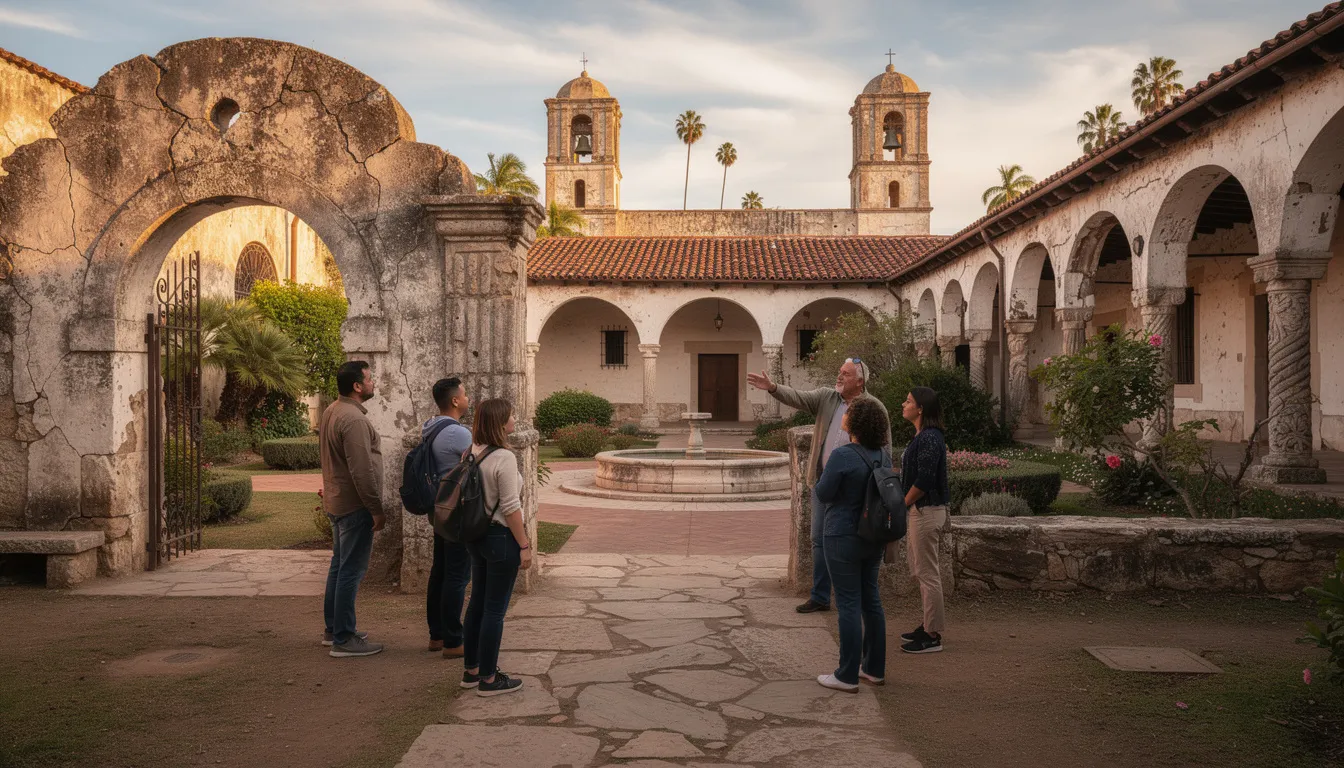
Even in partial ruin, the Great Stone Church commands attention. Its shattered transept, thick stone pilasters, and half-standing arches hint at the grandest church in Alta California, designed with a dome that was rare on the coast. The surviving footprint creates one of the most photogenic courtyards in the mission system.
Serra Chapel, by contrast, is intimate and warm. Step inside to see a glowing baroque altarpiece imported from Spain, painted ceilings, and worn floor tiles that thousands of feet have polished. Many consider it the oldest continuously used church in California, a rare chance to experience worship in an 18th-century space.
Around the central garden, arcaded walkways lead to rooms that once served as padres’ quarters, kitchens, and workshops. Look for original doors with iron strap hinges, an olive mill, and displays that explain tile and adobe making. The koi fountain anchors the courtyard, and the bell wall frames a classic mission view when the afternoon sun paints the adobe honey-gold.
Visiting the Mission
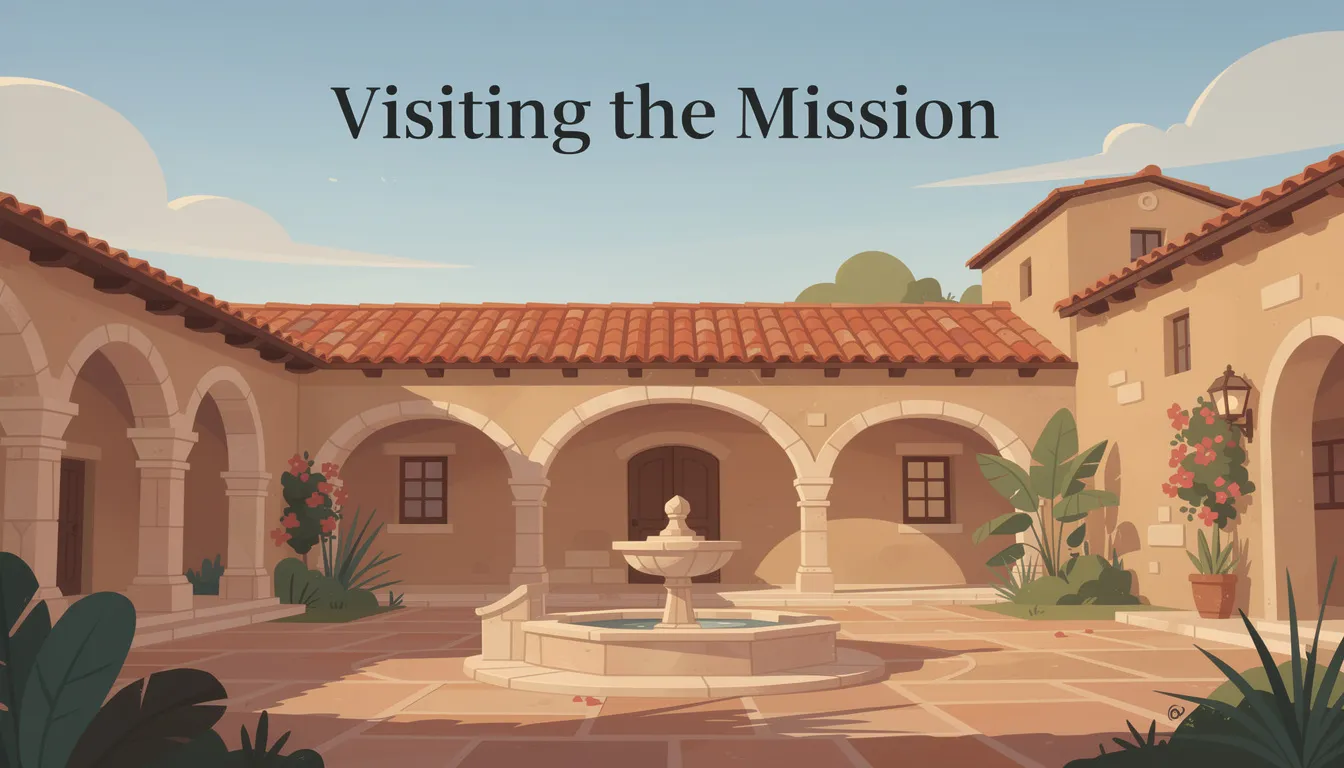
Whether you have an hour or a half day, planning pays off at mission san juan capistrano. Mornings are usually quieter, with soft light for photographs, and late afternoons bring a golden glow to the arcades. Weekends can be lively with tours and school groups, so consider weekday visits if you want extra breathing room.
The famous swallows are the mission’s seasonal celebrities. The community celebrates their return around St. Joseph’s Day, near March 19, with festivities that spotlight centuries of folklore. In recent years, the mission has supported conservation by installing clay nests and creating swallow-friendly habitats, which enrich both science and tradition.
Visitor Information
Before you go, a few simple choices can make your visit smoother and more rewarding. Policies and programs can change, so confirm details on arrival at the visitor desk.
- Timing: Arrive early for quieter courtyards, or after 3 pm for flattering light in the Great Stone Church ruins.
- Tours and audio: Docent-led tours bring stories to life, and an audio guide helps if you prefer to explore at your own pace.
- Respectful visiting: Dress for a place of worship if entering chapels, speak softly inside Serra Chapel, and follow photography rules. No flash in sacred spaces.
- Family-friendly: Pick up a scavenger hunt or activity sheet for kids. The gardens and koi pond are big hits with young visitors.
- Accessibility: Many paths are level, with ramps to key areas. Ask for accessible routes to the chapel and museum rooms.
- Essentials: Bring water, a hat, and comfortable shoes. Tripods and drones may require permits or be restricted.
- Parking and food: Public parking and local cafes are a short walk away in the historic district, making it easy to pair your visit with lunch.
Events and Activities
The mission’s calendar weaves history with community life. Seasonal concerts set strings or choir against the stone backdrop. Art workshops invite you to sketch arcades or paint native plants in the gardens. Cultural days showcase Indigenous traditions and regional crafts, and holiday programs fill the grounds with music and lights.
If you hope to see the swallows, aim for early spring and check for talks that explain their migratory patterns and habitat needs. For photographers, look for after-hours sessions or special access days when the courtyards are less crowded, and consider returning in different seasons to capture the garden at its peak bloom.
Significance of the Mission Today
Beyond its postcard views, mission san juan capistrano helps visitors grapple with California’s layered past. Exhibits and docent narratives increasingly foreground the experiences of the Acjachemen (Juaneño) people, whose language, crafts, and stories continue to shape the mission’s interpretation. This inclusion adds needed dimension to a site that was once told mainly through a colonial lens.
The mission also serves as a center for conservation and learning. Restoration labs test mortars that let adobe breathe in coastal humidity. Garden teams cultivate native and heritage plants that teach about foodways and medicine. School programs introduce students to archaeology basics, primary sources, and the complex realities of mission life.