Step outside the station door and the air pinches your lungs with crystalline cold, the sky arching overhead like ink flecked with stars even at noon. Life at the Amundsen-Scott South Pole Station is both rugged and precise, a choreography of science and survival at Earth’s axis. Researchers chase neutrinos, map the oldest light in the universe, and track our changing atmosphere while sharing meals, music, and stories. What seems like a remote outpost quickly becomes a tightly knit, purpose-driven community.
💡 Key Takeaways
- The Amundsen-Scott Station is located at 90°S, at an elevation of 2,835 meters.
- Temperatures can drop below -80°C during winter months.
- The station supports over 40 different scientific research projects annually.
Overview of Amundsen-Scott South Pole Station
The amundsen-scott south pole station is a year-round research facility perched at the geographic South Pole, where all longitudinal lines converge. Operated by the U.S. National Science Foundation, it anchors a global network of polar science and logistics. From atmospheric chemistry and seismology to astrophysics and glaciology, it serves as the ultimate platform for experiments that demand cold, altitude, and extraordinary isolation.
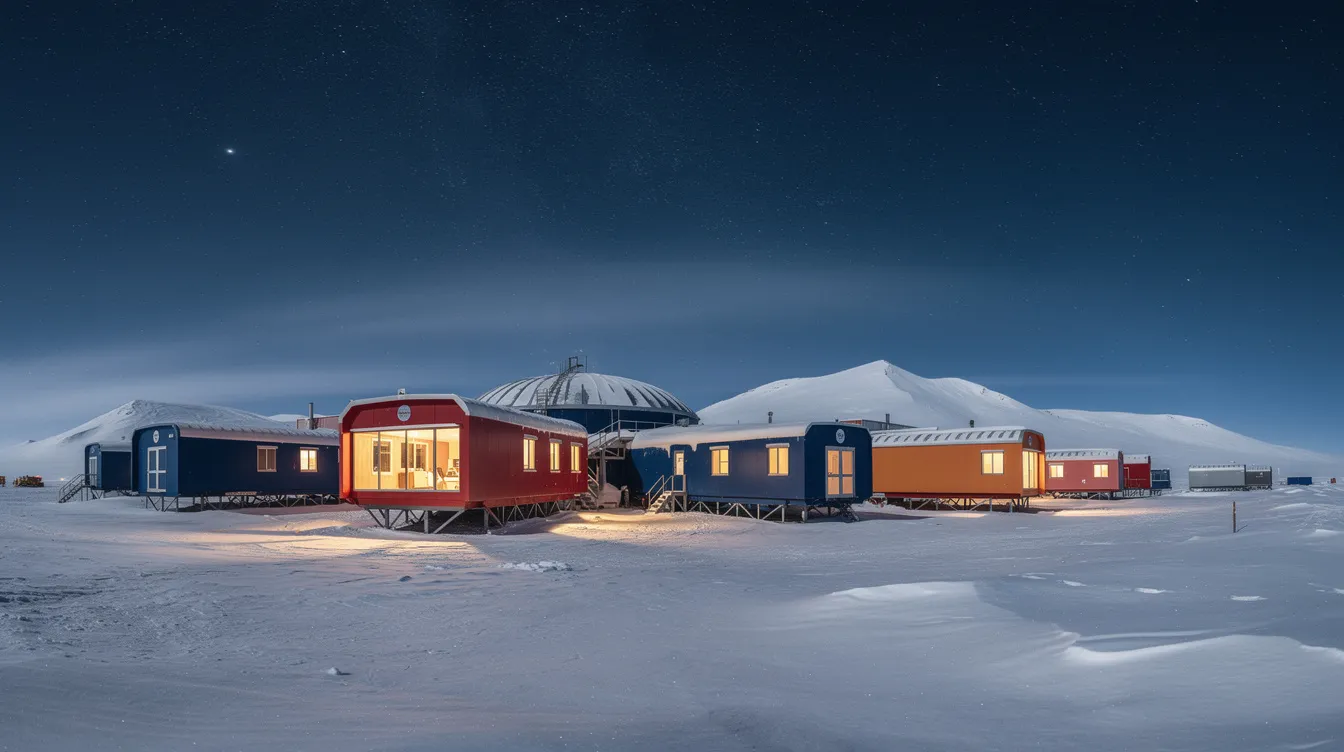
Sitting at 90°S on the Antarctic Plateau, the station resides on a desert of snow that is anything but empty. Inside its elevated steel-and-composite structure, labs and living spaces hum with activity. The site is the southernmost point under U.S. jurisdiction, a practical and symbolic edge of national presence in Antarctica. Summer transforms it into a bustling hub of resupply and construction, while winter pares the population to a small cadre of caretakers and scientists.
The station’s elevation of 2,835 meters imposes a physiological reality that colors every day. The thin, dry air sharpens stars and telescopes alike, letting researchers peer deep into cosmic history. It also demands careful acclimatization, hydration, and a measured pace for anyone newly arrived. Despite the harshness, the station is designed to be welcoming and efficient, with workshops, a galley, a gym, and cozy corners to gather when the wind moans and the temperature plunges.
Geographic Location and Access
Amundsen-Scott sits atop a moving ice sheet roughly 2,700 meters thick. The ice creeps about 10 meters a year, so technicians relocate the ceremonial and geographic pole markers annually to keep pace with the drift. Underfoot is not rock but compacted snow, which transmits temperatures quickly and keeps the surface firm, a helpful trait when aircraft land on skis during the short summer season.
Access is almost exclusively via McMurdo Station on the coast. During the austral summer, ski-equipped aircraft ferry people and cargo on a carefully groomed snow runway. In the strict “Clean Air Sector” downwind of the station, heavy machinery is limited so that sensitive atmospheric measurements remain pristine. I learned quickly that even a snowmobile idling in the wrong place can skew decades-long climate records.
History and Establishment
Construction began in 1956 as part of preparations for the International Geophysical Year, a coordinated global scientific campaign that transformed polar research. The original “Old Pole” station was mostly buried by drifting snow within a decade, an early lesson in how Antarctica reclaims any structure that does not rise above the surface. A geodesic dome replaced it in the 1970s, itself eventually surpassed by the current elevated station, whose aerodynamic profile and adjustable supports help shed snow.
From the first winterover through today, the facility has been continuously occupied, an unbroken human presence at the bottom of the world. That continuity matters for climate records, seismology networks, and long-baseline astronomy. It also matters to the culture of the place. Traditions pass from crew to crew, and wisdom on everything from frostbite prevention to making perfect bread at altitude is handed down as carefully as any instrument manual.
Historical Milestones
Highlights include the dome era’s iconic silhouette; the commissioning of the Atmospheric Research Observatory during the 1990s to track greenhouse gases; the deployment of the South Pole Telescope in 2007; and the completion of the IceCube Neutrino Observatory, which announced its first high-energy cosmic neutrinos at the start of the last decade. Each milestone layered capabilities until the station became the comprehensive science campus it is today.
Unique Environment and Climate
The South Pole is a paradox: a frozen desert with some of the clearest, driest air on Earth. Winter temperatures can plunge below -80°C, and even summer highs rarely rise above -25°C. The air holds little moisture, which reduces cloud cover and frees telescopes from the blurring effect of water vapor. The result is a sky that looks almost electric, stars so steady that time itself feels slower as you gaze.
Light at the Pole behaves differently because of the planet’s tilt. The sun rises once a year and sets once a year, creating a months-long day and a months-long night. During polar night, the aurora australis ripples overhead so frequently that it becomes a kind of weather. Walking to the lab under that shifting green ribbon is a memory that imprints, a reminder that space weather is as present here as atmospheric weather.
Wind is usually moderate at the Pole compared with the coasts, where katabatic winds roar down from the plateau. What makes the Pole punishing is not gale force but persistence and depth of cold. Tiny ice crystals known as “diamond dust” often glitter in the air, and a strong temperature inversion traps cold air near the surface. Even a small skin exposure can frost over in minutes, so glove liners and face masks become second nature.
Temperature and Weather Patterns
Seasonal patterns are stark. The long summer brings continuous sunlight, improved visibility, and a steady resupply tempo. The long winter brings continuous darkness, intense cold, and no flights for months. Pressure systems are relatively stable, but altitude-corrected barometric pressure can drop enough during storms to make breathing feel more strenuous. Forecasting relies on satellite data, balloon launches, and experience; you learn to read the quality of the sky, not just the numbers.
Research Opportunities
The amundsen-scott south pole station supports over 40 scientific projects each year, a portfolio that shifts as experiments complete and new ones arrive. The common theme is that the Pole offers something irreplaceable: unparalleled sky clarity for millimeter and submillimeter astronomy, the thick and exceptionally pure ice for neutrino detection, and a baselined clean-air environment for climate measurements that can anchor global datasets.
As a field tech, I watched instruments hum through the night while a handful of researchers posted real-time plots on lounge monitors. The diversity is striking. A seismometer pings the Earth’s deep rumbles, a laser ceilometer profiles ice crystals aloft, and magnetometers trace the solar wind’s tug on our planet’s protective shield. Experiments span the microscopic to the cosmic, and many run autonomously through the winter while humans conserve energy and warmth.
- Cosmology: South Pole Telescope and BICEP/Keck arrays mapping the cosmic microwave background’s temperature and polarization.
- Particle astrophysics: IceCube Neutrino Observatory catching ghostly particles from supernovae and distant galaxies.
- Atmospheric chemistry: NOAA’s Atmospheric Research Observatory measuring CO2, ozone, and aerosols in the Clean Air Sector.
- Space weather: All-sky cameras and magnetometers tracking auroras and geomagnetic disturbances.
- Geophysics and glaciology: GPS and seismology stations monitoring ice flow, crustal motion, and seismic activity.
For aspiring polar scientists, the advice I give is practical. Design for cold. Anything with a battery will underperform if it is not insulated and warmed. Use materials tested for brittleness at extreme lows. Plan for maintenance that can be performed with mittens on. Documentation needs to be clear enough that a winter crew can troubleshoot by headlamp when the nearest manufacturer is a hemisphere away.
Astrophysical Research Projects
Astrophysics dominates because the site is uniquely quiet, dark, and stable. The South Pole Telescope targets faint ripples in the cosmic microwave background, sharpening our understanding of dark energy and the evolution of structure in the universe. The BICEP/Keck experiments push at the frontier of detecting primordial gravitational waves via polarization patterns, an audacious attempt to eavesdrop on the first instants after the Big Bang.
Meanwhile, IceCube transforms the ice itself into a detector, using an instrumented cubic kilometer of Antarctic ice to capture flashes of Cherenkov light from neutrino interactions. These observations open a new window on the high-energy universe that photons and cosmic rays alone cannot provide. The placement of a neutrino observatory at the Pole is not a coincidence; cold, clear ice and continuous winter darkness converge to make it possible.
Living Conditions at the South Pole
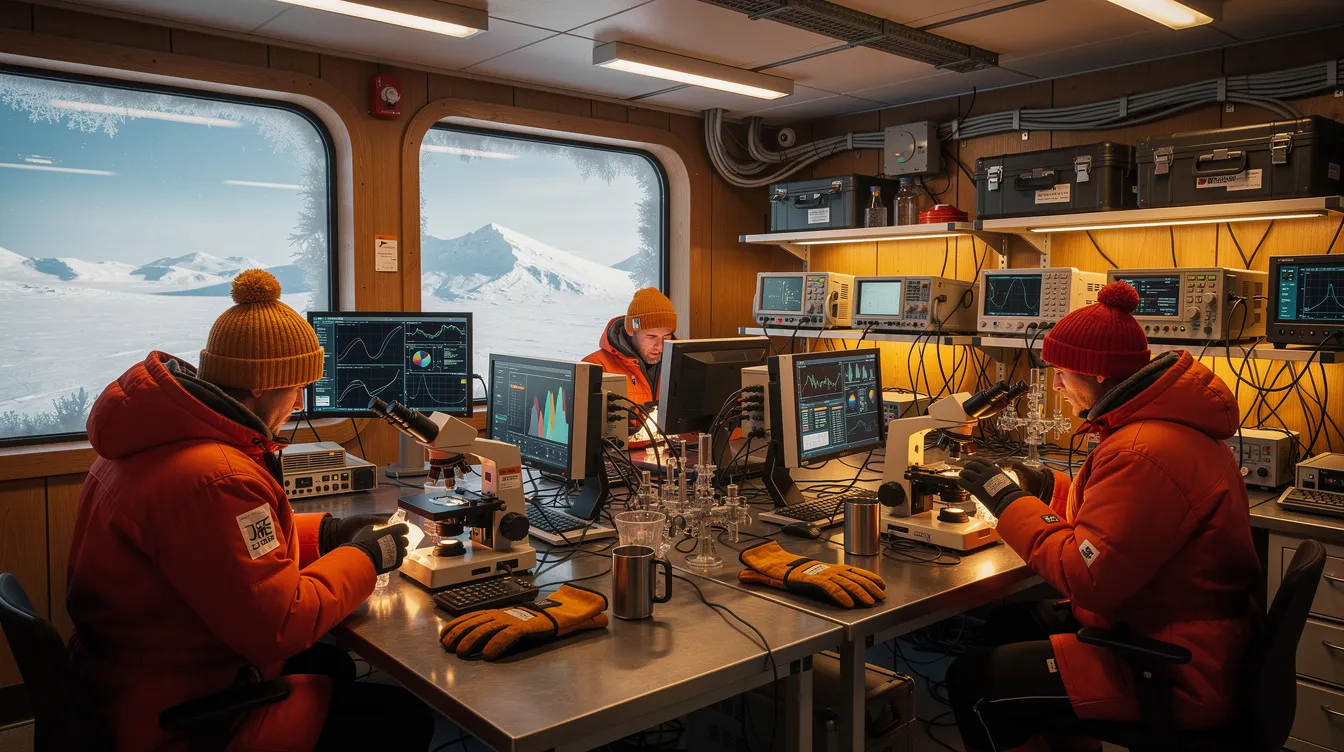
Daily life at the amundsen-scott south pole station is practical, rhythmic, and surprisingly warm once you step indoors. The station’s galley is the social heart, serving heaping plates of hot food that fuel both science and snow shoveling. Freshies, as we call fresh produce, are precious. That is why the station’s hydroponic greenhouse becomes a sanctuary where crew members clip lettuce and basil under LED grow lights while chatting over the hum of pumps.
Rooms are compact and private, a welcome refuge when winds rise. The air is exceptionally dry, so lip balm and nasal saline are staples. I keep a small humidifier running through the winter; it helps sleep and reduces static shocks that plague electronics. Layers of clothing live by the door so you can respond quickly to an alarm or a breathtaking aurora alert. Wearing the right boots and a face mask is not bravado; it is risk management.
Water starts as snow shoveled into the rodwell system, which melts it using waste heat. Power comes from diesel generators feeding an efficient microgrid, with heat scavenged to warm buildings and the water plant. Safety is a constant, quiet presence. From fire drills to vehicle training, every crewmember learns the basics of keeping one another safe in a place where simple mistakes can escalate.
Communications are improving but still limited. Satellite windows provide bursts of high-speed data, then drop to low-bandwidth channels overnight. This rhythm shapes habits. I download papers and podcasts during windows and draft emails offline. Friends and family learn that replies come in batches. Oddly, the constraint feels freeing; conversations in the lounge become deeper without the constant tug of streaming feeds.
Facilities and Amenities
The station’s amenities are designed to sustain both body and mind. There is a gym with free weights and cardio machines, a music room with instruments, a small movie lounge, a workshop bristling with tools, and a library of paperbacks that cycle with each crew. The medical clinic handles most routine and urgent care, with telemedicine support for complex cases.
A few spaces take on almost mythic status by winter’s end. The sauna is a favorite on the coldest nights, and those brave enough might attempt the 300 Club: sprinting outside after heating to 93°C on a night when the ambient temperature hits -73°C to experience a 100°C drop. The winterover photo wall grows each season, a gallery of faces that says as much about resilience and camaraderie as any scientific poster.
Transportation and Logistics
Getting to the South Pole is a multi-stage journey that depends on timing and weather. Flights typically move personnel from Christchurch, New Zealand, to McMurdo Station. From there, ski-equipped LC-130 Hercules aircraft hop to the Pole during the short austral summer. The rest of the year, the skies go quiet. No planes land during winter, so careful planning ensures that fuel, food, and critical spares are stockpiled before the sun sets.
Surface logistics are equally impressive. The South Pole Overland Traverse (SPoT) sends tractors and sled trains across the plateau each summer, hauling fuel bladders and cargo, then returning with compacted waste for removal under Antarctic Treaty protocols. Every kilogram matters in this system. Instruments are crate-optimized, and even kitchen supplies are specified for cold performance. I have seen a simple plastic spatula shatter like glass at -50°C; materials science is not a luxury here.
- Plan for the austral summer window from roughly October to February; most flights and heavy cargo move only then.
- Stage in Christchurch and McMurdo, completing cold-weather training and gear issue before heading inland.
- At the Pole, cargo is offloaded onto groomed snow with specialized sleds and tracked vehicles to prevent sinking.
- Waste and used equipment are retrograded by air or SPoT, keeping the station’s footprint as light as possible.
Fuel is a special case. Aircraft burn AN-8 and the station’s generators run on similar cold-rated fuels. Temperature management extends to hoses, pumps, and filters, which can gum or crack if not conditioned. Even paperwork takes logistics into account; resupply manifests are meticulously cross-checked because a mislabeled crate might not be openable again for months once winter locks in.
Travel to the South Pole
Most visitors are scientists, technicians, or support staff on official programs. A small number of tourists arrive via specialized operators based on the continent’s interior runways, usually staging through Union Glacier. Permits, insurance, medical screenings, and strict environmental compliance are mandatory across the board. Personal electronics must be shielded from cold and static, and camera batteries should be cycled in inner pockets between shots to keep them alive.
For scientists proposing new projects, the path runs through peer review and detailed logistics plans that account for every watt, kilogram, and minute of field time. The amundsen-scott south pole station rewards those plans with a platform unlike any other on Earth, but it also demands respect for the reality that the weather always gets the final vote.
Community Life and Activities
Science may be the station’s mission, but community is what makes the mission sustainable. The amundsen-scott south pole station is a village of cooks, carpenters, engineers, scientists, and janitors who rotate roles to keep the place humming. A Tuesday night lecture might be followed by a jam session. A snowstorm might prompt a spontaneous bread-baking contest. People swap skills freely, from soldering to sourdough, and everyone shows up for the big annual traditions.
Midwinter is the emotional summit. When the sun has been gone for months, the crew celebrates with a formal dinner, messages exchanged with other Antarctic stations, and screenings of classic polar films. The 300 Club only opens for those rare nights cold enough to qualify, but the laughs and steam drifting into the cosmos are for everyone. In late summer, when the first plane appears on the horizon, the cheers echo through the corridors.
Social Events and Community Involvement
Regular events include trivia nights, arts and crafts workshops, and the occasional South Pole Marathon looping over groomed snow. Volunteers staff the fire crew, search and rescue, and medical response teams. Those teams train hard, and that shared responsibility builds trust that spills over into daily life. I have watched a welder and an astronomer trade tools and notes with the same care, respecting each other’s disciplines because both keep the station alive.
Community extends to stewardship. Recycling is rigorous, and everyone participates in waste sorting and cleaning. The greenhouse crew shares herbs and salad fixings. The galley posts menus and invites feedback, often adapting to dietary needs with impressive creativity. Small touches, like a birthday cake or a surprise taco night, can reset morale in a way no policy memo ever could.
Standing under the aurora with friends after a long day, you feel how the station’s purpose and its people entwine. The work done here ripples outward through climate models, astrophysical catalogs, and technical manuals used around the world. If the South Pole has a lesson, it is that curiosity and cooperation thrive in even the harshest places. Pack your patience, keep your batteries warm, and remember to look up. The sky at the end of the Earth is worth the journey.