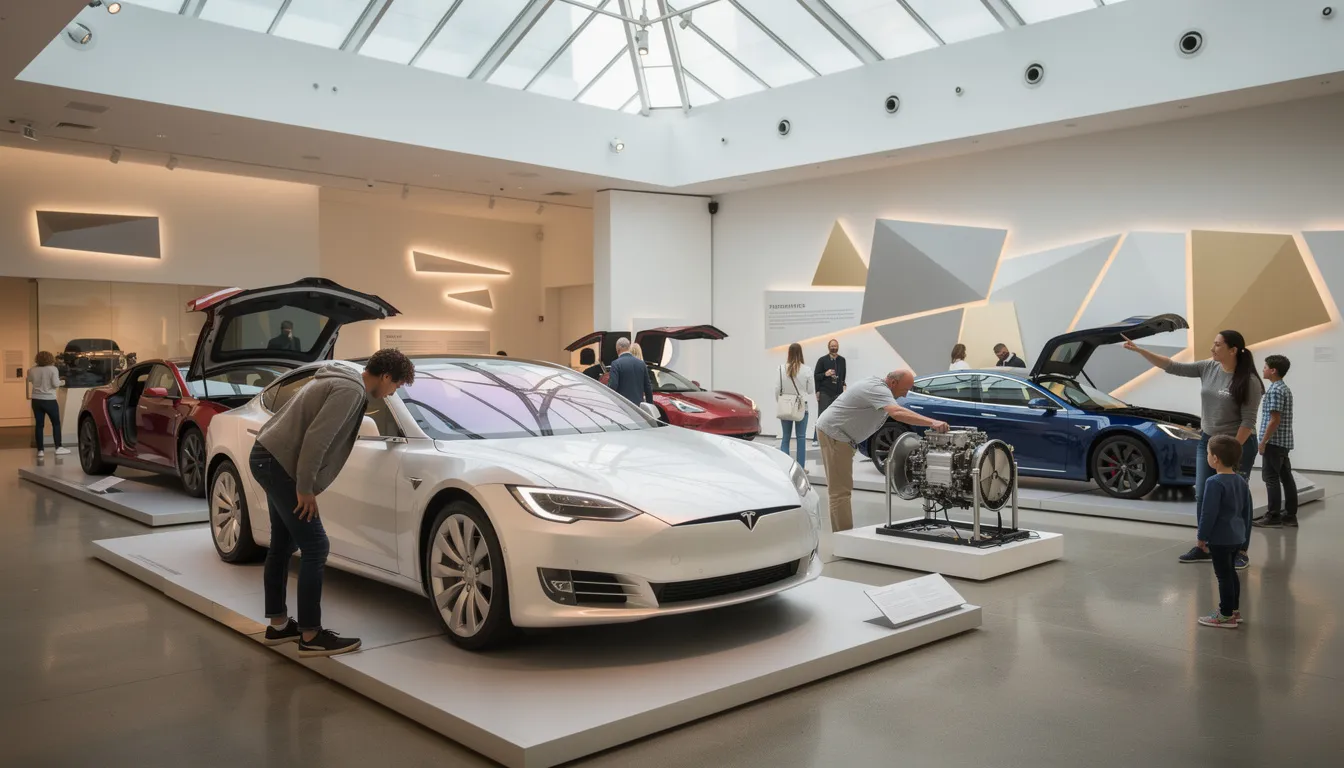
Step inside a gallery where the past, present, and future of mobility meet. Tesla’s story comes alive in Los Angeles with a dedicated showcase that blends rare vehicles, hands-on tech, and design artifacts. Whether you are a long-time fan or new to EVs, tesla at the petersen museum turns complex engineering into an accessible, eye-opening experience. Expect to leave with a deeper appreciation for how innovation scales from a sketch to the road.
💡 Keys Takeaways
- Tesla was founded in 2003 and has revolutionized electric vehicles.
- The Petersen Museum houses over 300 vehicles, showcasing automotive history.
- The exhibit features interactive displays and rare Tesla models.
Tesla at the Petersen Museum: Why It Matters
Los Angeles is a city that celebrates the automobile as culture, design, and technology. That spirit is distilled in the Petersen Automotive Museum, a landmark that curates pivotal moments in mobility. When you explore tesla at the petersen museum, you see how a startup matured into a global force, and how design studios, software teams, and factories converged to reshape what a car can be.
The Petersen’s collection spans more than a century of innovation with over 300 vehicles under its roof. This setting adds context to Tesla’s rise, placing a Roadster next to icons of the internal combustion era, or pairing a battery pack with historic race cars. The result is a narrative that shows progress as a chain of ideas, not a single breakthrough.
The Role of the Petersen Museum in Automotive History
The Petersen advances car culture through scholarly curation, immersive exhibits, and public programs. It documents design and engineering with the same rigor applied to art or architecture, which is why its showcases often become reference points for historians and enthusiasts.
What sets the museum apart is how it connects the dots. One floor might chart manufacturing techniques, while another unpacks styling and aerodynamics. Tesla’s story benefits from that multi-angle view, letting you compare early EV experiments with modern lithium-ion architectures, or trace how California’s innovation ecosystem fostered new business models and software-forward vehicles.
History of Tesla’s Innovations
Tesla was founded in 2003 with a simple thesis that electrification could beat gasoline on performance and efficiency. The first proof arrived with the 2008 Roadster, a sports car that used commodity laptop cells arranged in sophisticated modules. That choice kicked off a decade of battery-scale learning and thermal management insights that rippled across the industry.
With Model S, Tesla normalized long-range EV travel and made over-the-air updates mainstream. Software became a core feature, not an afterthought. The sedan’s skateboard platform packaged batteries low and flat, improving handling and cabin space. Then came the Supercharger network, a coordinated charging backbone that reframed road trips and reduced range anxiety for early adopters.
Later models diversified the lineup. Model X introduced dramatic doors and family-first packaging. Model 3 and Model Y focused on affordability and manufacturing scale, proving that consumer demand exists far beyond luxury niches. Many of these milestones are illuminated through artifacts, prototypes, and components that you can study up close when you explore tesla at the petersen museum.
How Tesla Changed the Automotive Industry
- Shift to software-defined cars with frequent feature updates pushed competitors to prioritize code quality, UX, and connectivity.
- Fast-charging infrastructure planning influenced public and private investment, accelerating national charging standards.
- High-efficiency powertrains and energy-dense battery packs set new baselines for range and performance in mainstream segments.
- Manufacturing breakthroughs such as large castings and simplified wiring harnesses inspired new plant layouts and cost models.
- Direct engagement with customers elevated data-driven product development and rapid iteration cycles.
What to Expect from the Exhibit
The Tesla exhibit blends storytelling with technology. Expect cutaway components, historical timelines, and stations that explain how electric motors, inverters, and battery modules turn electrons into motion. You will find interactive displays that translate complex systems into tactile learning, from aerodynamic modeling to energy management and safety design.
The exhibition often pairs vehicles with the ideas that shaped them. A prototype might sit beside early sketches, or a battery pack might be flanked by charging maps and materials samples. This approach highlights rare prototypes, engineering trials, and design mockups, creating a walkable blueprint of how a concept matures into a production car. If you are curious about how software supports hardware, tesla at the petersen museum provides a clear, engaging answer.
Highlights of the Tesla Exhibit
- Early Roadster examples that reveal how a small team leveraged lithium-ion cells and power electronics to unlock sports-car performance.
- Model S displays that showcase the flat battery “skateboard” and dual-motor all-wheel drive architecture.
- Model X features with close looks at the Falcon Wing hinges and packaging around a three-row EV.
- Prototype showcases that have included attention-grabbing designs, inviting a closer look at body structures and materials choices.
- Charging and energy sections that demystify home charging, Superchargers, and stationary storage like Powerwall with component-level views.
Photography is generally welcome, so bring a lens that handles indoor lighting. Families will appreciate kid-friendly labels and hands-on stations that make complex ideas digestible. If you enjoy comparing eras, take a few minutes to step into adjacent galleries and see how earlier experiments in electrification paved the way for modern EV platforms.
Visitor Information and Tips
The museum sits in the Miracle Mile district on Wilshire Boulevard, a cultural corridor that also includes notable art and science institutions. Traffic varies by day and time, so plan a buffer for arrival and parking. Weekday mornings are quieter, which makes it easier to spend unhurried time at each station within tesla at the petersen museum. Weekends have more energy and special programming, though galleries can fill up fast.
Tickets can sell quickly for headline exhibitions. Booking ahead helps you secure your preferred entry window, and it also gives you time to add special experiences. The Petersen’s subterranean “Vault” tours, for example, rotate rare vehicles not seen upstairs. If you want to see as much as possible in one visit, consider a mid-morning slot, break for lunch in the neighborhood, then return for a slower second pass through the sections that interested you most.
Planning Your Visit: Hours and Admission
The museum typically operates from 10 am to 5 pm with last entry about an hour before closing, and holiday schedules can shift. Admission is tiered with discounts for students, seniors, and youth, and add-ons like Vault tours are a separate charge. If you plan to see multiple galleries plus tesla at the petersen museum, budget two to three hours to keep the pace comfortable.
- Arrive early for easier parking and to enjoy spacious galleries before mid-day crowds.
- Set aside time for the ground-floor lobby displays and the museum store, which offers design books and scale models.
- Check for docent talks or family programs that can deepen context around EV technology and design.
- Bring a light jacket since gallery temperatures are kept cool to protect vehicles and materials.
- Accessibility is strong, with elevators and wide pathways that make it simple to navigate with strollers or mobility devices.
The Future of Electric Vehicles
EVs are transitioning from early adoption to mass relevance. Costs continue to fall as scale improves, chemistry diversifies, and manufacturing becomes more efficient. Charging is moving beyond simple plugs to smart systems that balance speed, grid demand, and renewable energy inputs. Battery supply chains are localizing and circularity is accelerating through battery recycling and second-life applications.
Policy and infrastructure growth will shape the next chapter. Cities are designing curbside charging, apartments are adding shared solutions, and fleets are electrifying delivery routes. Software will orchestrate energy flows from car to home and grid with bidirectional charging, while driver-assistance matures with better sensing and compute. When you take in tesla at the petersen museum, you see how these threads are converging into vehicles that are more efficient, safer to operate, and easier to live with.
Why Electric Vehicles Matter
- Cleaner air and lower lifecycle emissions improve public health and reduce climate risks as grids adopt more renewables.
- Instant torque and a low center of gravity deliver performance and control that drivers notice on day one.
- Home charging offers convenience and predictable costs compared to fluctuating fuel prices.
- Domestic energy and diversified supply chains strengthen resilience against global fuel shocks.